
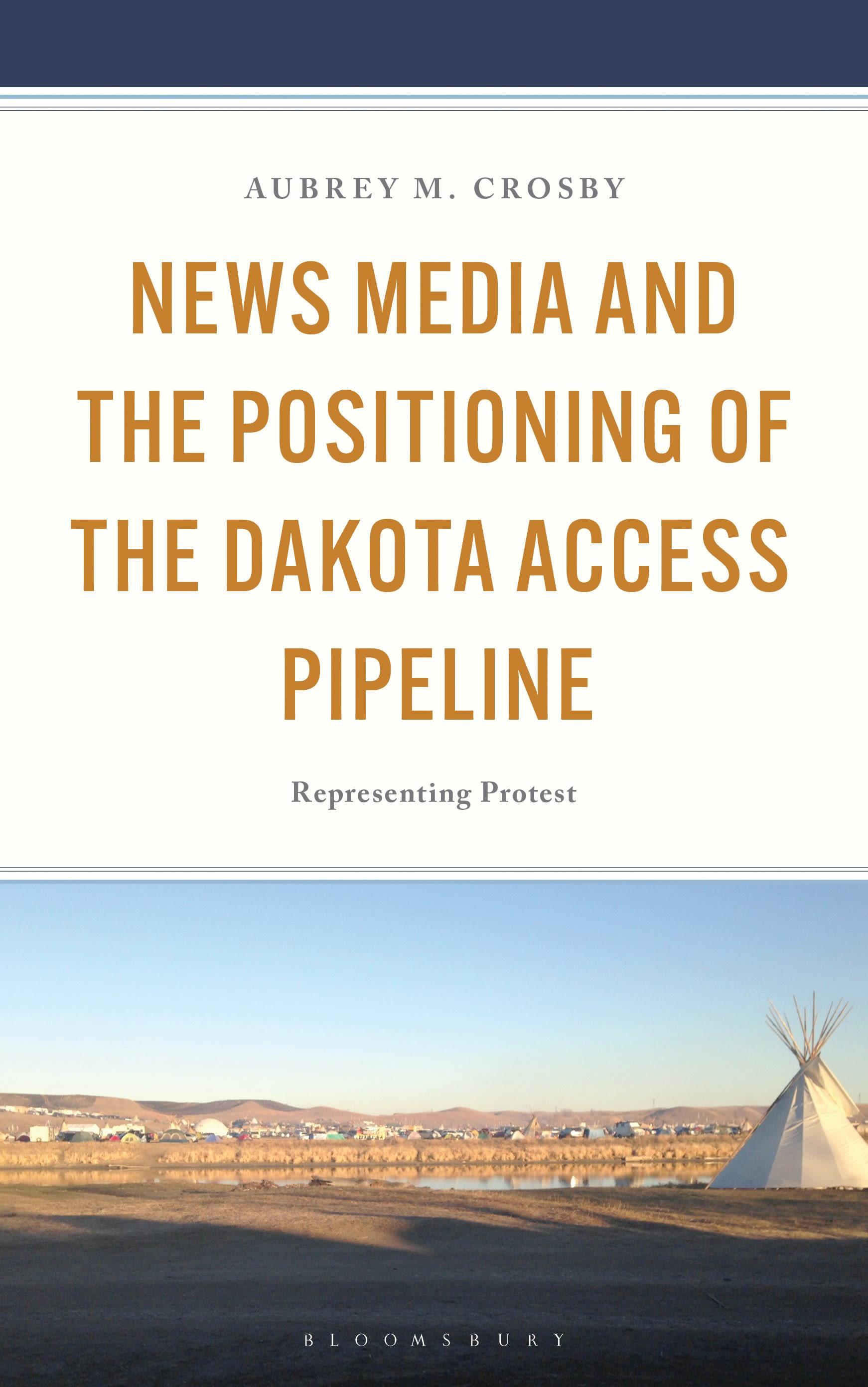
In News Media and the Positioning of the Dakota Access Pipeline: Representing Protest, Aubrey M. Crosby examines the structural and institutional forces governing the socialized practices of news production to provide a constructive critique of how news media frame events and participants in their protest coverage.
Crosby utilizes original data and the frameworks of critical discourse analysis, systemic functional linguistics, and the protest paradigm to perform critical analysis of mainstream news reporting of the Dakota Access Pipeline (DAPL) protests in 2016. She argues that news media significantly reduced the scope of the movement and (re)framed the reality of the #NoDAPL protests by fixating only on select key events and by painting participants as a collective monolith of “protestors,” a functional term which highlights their civil disobedience and erases their individual identities.
Though journalists may have had the opportunity and means to engage more critically with existing discourses, especially those surrounding Indigenous and Tribal sovereignty, mainstream reporting made little effort, if any, to do so. Through rigorous analysis, Crosby demonstrates how “protestors” were aligned with negative actions associated with emotional and destructive intent and juxtaposed with law enforcement, whose aggressive and ethically ambiguous actions were reframed as attempts to maintain law and order. Ultimately, by identifying and drawing attention to both problematic and productive practices of coverage, this work promotes constructive change regarding how power is wielded, maintained, and produced in organizations and in the social realm.
Crosby utilizes original data and the frameworks of critical discourse analysis, systemic functional linguistics, and the protest paradigm to perform critical analysis of mainstream news reporting of the Dakota Access Pipeline (DAPL) protests in 2016. She argues that news media significantly reduced the scope of the movement and (re)framed the reality of the #NoDAPL protests by fixating only on select key events and by painting participants as a collective monolith of “protestors,” a functional term which highlights their civil disobedience and erases their individual identities.
Though journalists may have had the opportunity and means to engage more critically with existing discourses, especially those surrounding Indigenous and Tribal sovereignty, mainstream reporting made little effort, if any, to do so. Through rigorous analysis, Crosby demonstrates how “protestors” were aligned with negative actions associated with emotional and destructive intent and juxtaposed with law enforcement, whose aggressive and ethically ambiguous actions were reframed as attempts to maintain law and order. Ultimately, by identifying and drawing attention to both problematic and productive practices of coverage, this work promotes constructive change regarding how power is wielded, maintained, and produced in organizations and in the social realm.
Pages: 120
Catégorie: Film- & Medievetenskap
e-ISBN: 9781978765054
Poids d'expédition: 1.2 kg
Expédié sous: 1-2 jours
Payez facilement par carte, Klarna, Apple Pay ou Google Pay. Pas satisfait ? Vous avez toujours une garantie de remboursement de 14 jours. En savoir plus dans nos conditions. Si vous avez des questions, envoyez-nous un e-mail à hello@memmo.org.
Memmo facilite tes études, où que tu sois dans le monde. On rassemble tes manuels de cours et des outils d'étude intelligents au même endroit : résumés, quiz, podcasts et flashcards. Et il y a Ted, ton compagnon d'étude qui répond à toutes tes questions. Plus de 50 000 étudiants étudient déjà ici – conçu pour t'aider à apprendre plus vite et à moins stresser.