
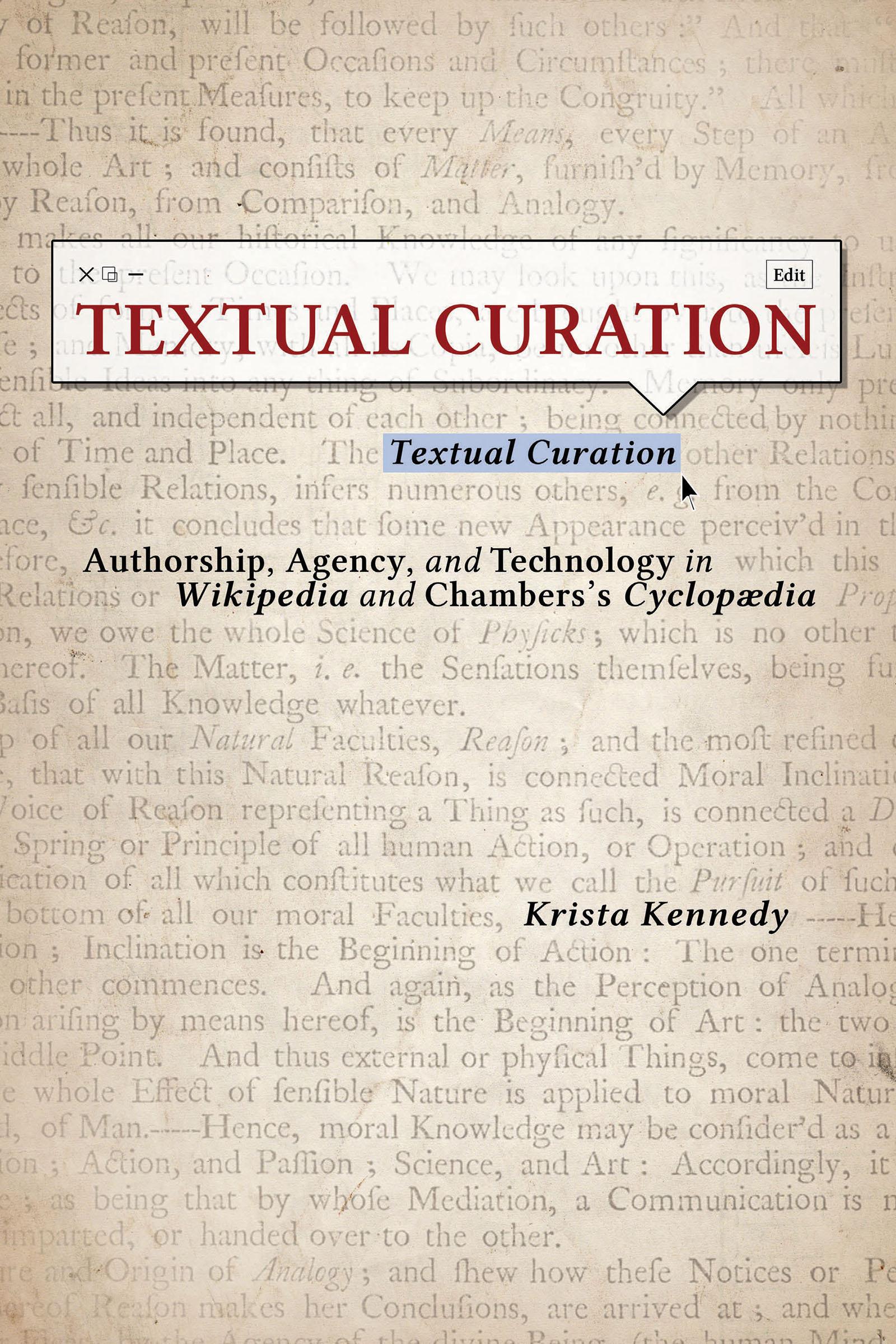
A study of the roles community, financial support, texts, information structures, interfaces, and technology play in collaborative works
Wikipedia is arguably the most famous collaboratively written text of our time, but few know that nearly three hundred years ago Ephraim Chambers proposed an encyclopedia written by a wide range of contributors—from illiterate craftspeople to titled gentry. Chambers wrote that incorporating information submitted by the public would considerably strengthen the second edition of his well-received Cyclopædia, which relied on previously published information. In Textual Curation, Krista Kennedy examines the editing and production histories of the Cyclopædia and Wikipedia, the ramifications of robot-written texts, and the issues of intellectual property theory and credit. Kennedy also documents the evolution of both encyclopedias as well as the participation of central players in discussions about the influence of technology and collaboration in early modern and contemporary culture.
Through this comparative study, based on extensive archival research and data-driven analysis, Kennedy illuminates the deeply situated nature of authorship, which is dependent on cultural approval and stable funding sources as much as it is on original genius and the ownership of intellectual property. Kennedy's work significantly revises long-held notions of authorial agency and autonomy, establishing the continuity of new writing projects such as wikis with longstanding authorial practices that she calls textual curation.
This study examines a wide range of texts that recompose accepted knowledge into reliable, complex reference works combining contributions of article text alongside less commonly considered elements such as metadata vocabularies, cross-indexing, and the development of print and digital interfaces. Comparison of analog and networked texts also lays bare the impact of technological developments, both in the composing process and in the topics that can practically be included in such a text. By examining the human and technological curators that support these encyclopedias as well as the discourses that surround them, Kennedy develops textual curation as a longstanding theory and process that offers a nuanced construction of authorship.
Payez facilement par carte, Klarna, Apple Pay ou Google Pay. Pas satisfait ? Vous avez toujours une garantie de remboursement de 14 jours. En savoir plus dans nos conditions. Si vous avez des questions, envoyez-nous un e-mail à hello@memmo.org.
Memmo facilite tes études, où que tu sois dans le monde. On rassemble tes manuels de cours et des outils d'étude intelligents au même endroit : résumés, quiz, podcasts et flashcards. Et il y a Ted, ton compagnon d'étude qui répond à toutes tes questions. Plus de 50 000 étudiants étudient déjà ici – conçu pour t'aider à apprendre plus vite et à moins stresser.