
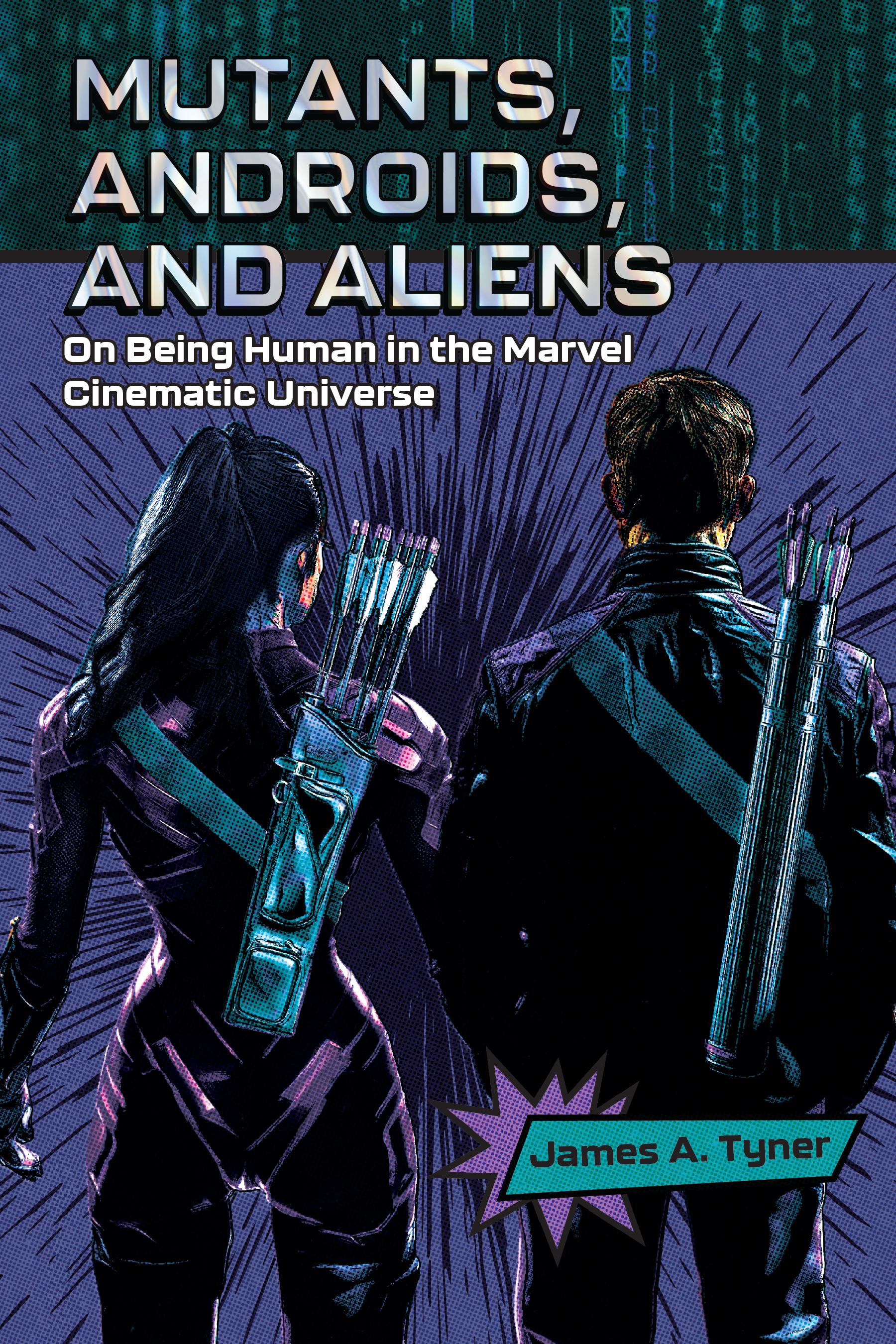
In both literature and film, mutants, androids, and aliens have long functioned as humanity’s Other—nonhuman bodies serving as surrogates to explore humanity’s prejudice, bigotry, and hatred. Scholars working in fields of feminism, ethnic studies, queer studies, and disability studies, among others, have deconstructed representations of the Othered body and the ways these fictional depictions provide insight into the contested terrains of identity, subjectivity, and personhood. In science fiction more broadly and the superhero genre in particular, the fictional Other—often a superhero or a villain—is juxtaposed against the normal human, and such Others have long been the subject of academic investigation.
Author James A. Tyner shifts this scholarly focus to consider the ordinary humans who ally with or oppose Othered superheroes. Law enforcement officers, military officials, politicians, and the countless, nameless civilians are all examples of humans who try to make sense of a rapidly changing more-than-human and other-than-human universe. The resulting volume, Mutants, Androids, and Aliens: On Being Human in the Marvel Cinematic Universe, provides a critical posthumanist reading of being human in the Marvel Cinematic Universe (MCU).
Centering the MCU’s secondary human characters, including Matthew Ellis, Ellen Nadeer, Rosalind Price, as well as Jimmy Woo, Sadie Deever, Holden Radcliffe, and others, Tyner considers how these characters attempt to monitor, incarcerate, or exterminate those beings considered "unnatural" and thus threatening. Placing into conversation posthumanism, environmental ethics, and myriad philosophical and biological ontologies of life and death, Tyner maintains that the superhero genre reflects the current complexities of meaningful life—and of what happens in society when "the human" is no longer the unquestioned normative standard.
Author James A. Tyner shifts this scholarly focus to consider the ordinary humans who ally with or oppose Othered superheroes. Law enforcement officers, military officials, politicians, and the countless, nameless civilians are all examples of humans who try to make sense of a rapidly changing more-than-human and other-than-human universe. The resulting volume, Mutants, Androids, and Aliens: On Being Human in the Marvel Cinematic Universe, provides a critical posthumanist reading of being human in the Marvel Cinematic Universe (MCU).
Centering the MCU’s secondary human characters, including Matthew Ellis, Ellen Nadeer, Rosalind Price, as well as Jimmy Woo, Sadie Deever, Holden Radcliffe, and others, Tyner considers how these characters attempt to monitor, incarcerate, or exterminate those beings considered "unnatural" and thus threatening. Placing into conversation posthumanism, environmental ethics, and myriad philosophical and biological ontologies of life and death, Tyner maintains that the superhero genre reflects the current complexities of meaningful life—and of what happens in society when "the human" is no longer the unquestioned normative standard.
Payez facilement par carte, Klarna, Apple Pay ou Google Pay. Pas satisfait ? Vous avez toujours une garantie de remboursement de 14 jours. En savoir plus dans nos conditions. Si vous avez des questions, envoyez-nous un e-mail à hello@memmo.org.
Memmo facilite tes études, où que tu sois dans le monde. On rassemble tes manuels de cours et des outils d'étude intelligents au même endroit : résumés, quiz, podcasts et flashcards. Et il y a Ted, ton compagnon d'étude qui répond à toutes tes questions. Plus de 50 000 étudiants étudient déjà ici – conçu pour t'aider à apprendre plus vite et à moins stresser.
Tu pourrais aussi aimer
Acheter le livre0