
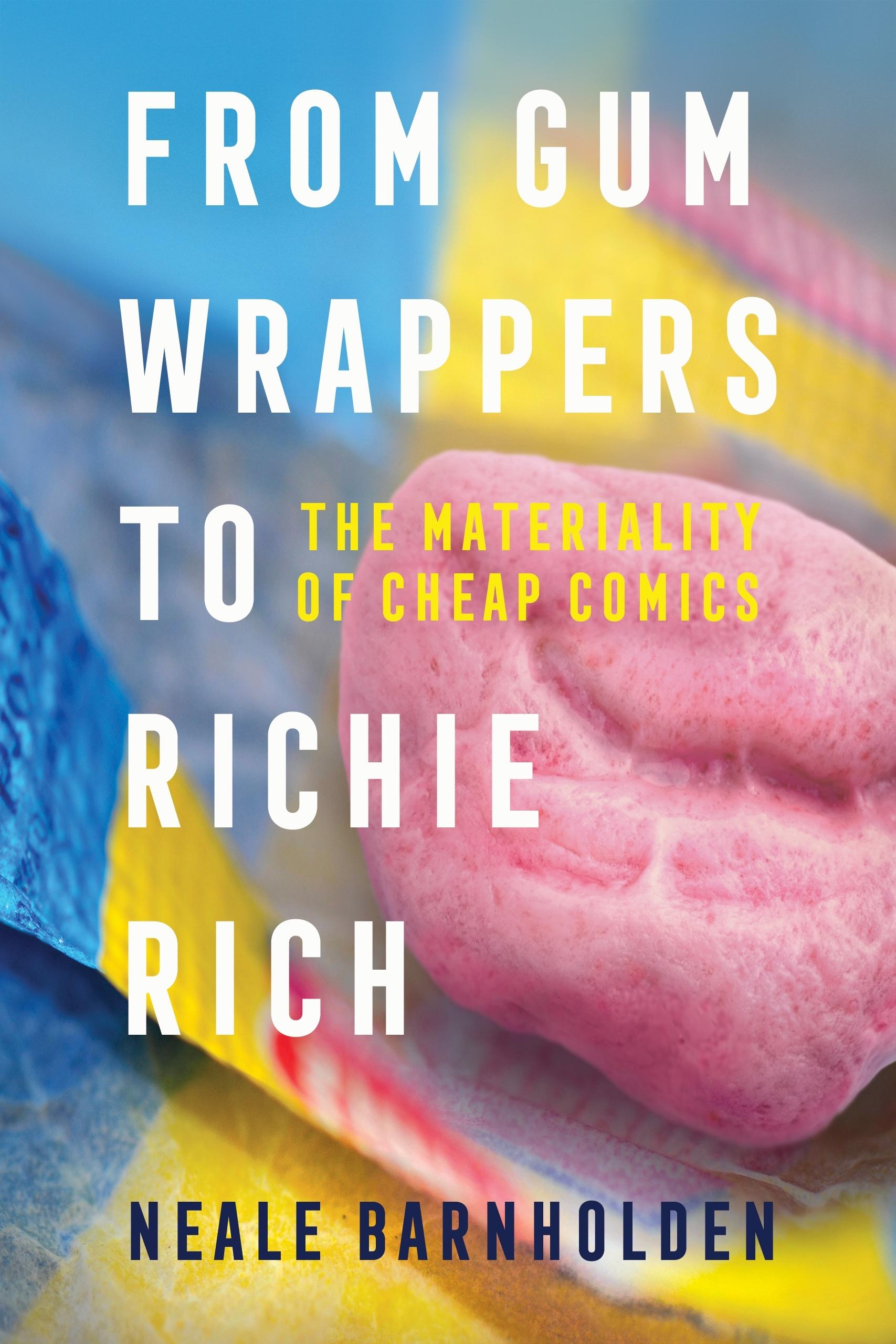
Between the 1930s and the invention of the internet, American comics reached readers in a few distinct physical forms: the familiar monthly stapled pamphlet, the newspaper comics section, bubblegum wrappers, and bound books. From Gum Wrappers to Richie Rich: The Materiality of Cheap Comics places the history of four representative comics—Watchmen, Uncle Scrooge, Richie Rich, and Fleer Funnies—in the larger contexts of book history, children’s culture, and consumerism to understand the roles that comics have played as very specific kinds of books. While comics have received increasing amounts of scholarly attention over the past several decades, their material form is a neglected aspect of how creators, corporations, and readers have constructed meaning inside and around narratives.
Neale Barnholden traces the unusual and surprising histories of comics ranging from the most acclaimed works to literal garbage, analyzing how the physical objects containing comics change the meaning of those comics. For example, Carl Barks’s Uncle Scrooge comics were gradually salvaged by a fan-driven project, an evolution that is evident when considering their increasingly expensive forms. Similarly, Watchmen has been physically made into the epitome of “prestigious graphic novel” by the DC Comics corporation. On the other hand, Harvey Comics’ Richie Rich is typically misunderstood as a result of its own branding, while Fleer Funnies uses its inextricable association with bubblegum to offer unexpectedly sophisticated meanings. Examining the bibliographical histories of each title, Barnholden demonstrates how the materiality of consumer culture suggests meanings to comics texts beyond the narratives.
Neale Barnholden traces the unusual and surprising histories of comics ranging from the most acclaimed works to literal garbage, analyzing how the physical objects containing comics change the meaning of those comics. For example, Carl Barks’s Uncle Scrooge comics were gradually salvaged by a fan-driven project, an evolution that is evident when considering their increasingly expensive forms. Similarly, Watchmen has been physically made into the epitome of “prestigious graphic novel” by the DC Comics corporation. On the other hand, Harvey Comics’ Richie Rich is typically misunderstood as a result of its own branding, while Fleer Funnies uses its inextricable association with bubblegum to offer unexpectedly sophisticated meanings. Examining the bibliographical histories of each title, Barnholden demonstrates how the materiality of consumer culture suggests meanings to comics texts beyond the narratives.
Pages: 184
Catégorie: Film- & Medievetenskap
e-ISBN: 9781496851635
Poids d'expédition: 1.2 kg
Expédié sous: 1-2 jours
Payez facilement par carte, Klarna, Apple Pay ou Google Pay. Pas satisfait ? Vous avez toujours une garantie de remboursement de 14 jours. En savoir plus dans nos conditions. Si vous avez des questions, envoyez-nous un e-mail à hello@memmo.org.
Memmo facilite tes études, où que tu sois dans le monde. On rassemble tes manuels de cours et des outils d'étude intelligents au même endroit : résumés, quiz, podcasts et flashcards. Et il y a Ted, ton compagnon d'étude qui répond à toutes tes questions. Plus de 50 000 étudiants étudient déjà ici – conçu pour t'aider à apprendre plus vite et à moins stresser.
Tu pourrais aussi aimer
Acheter le livre0