
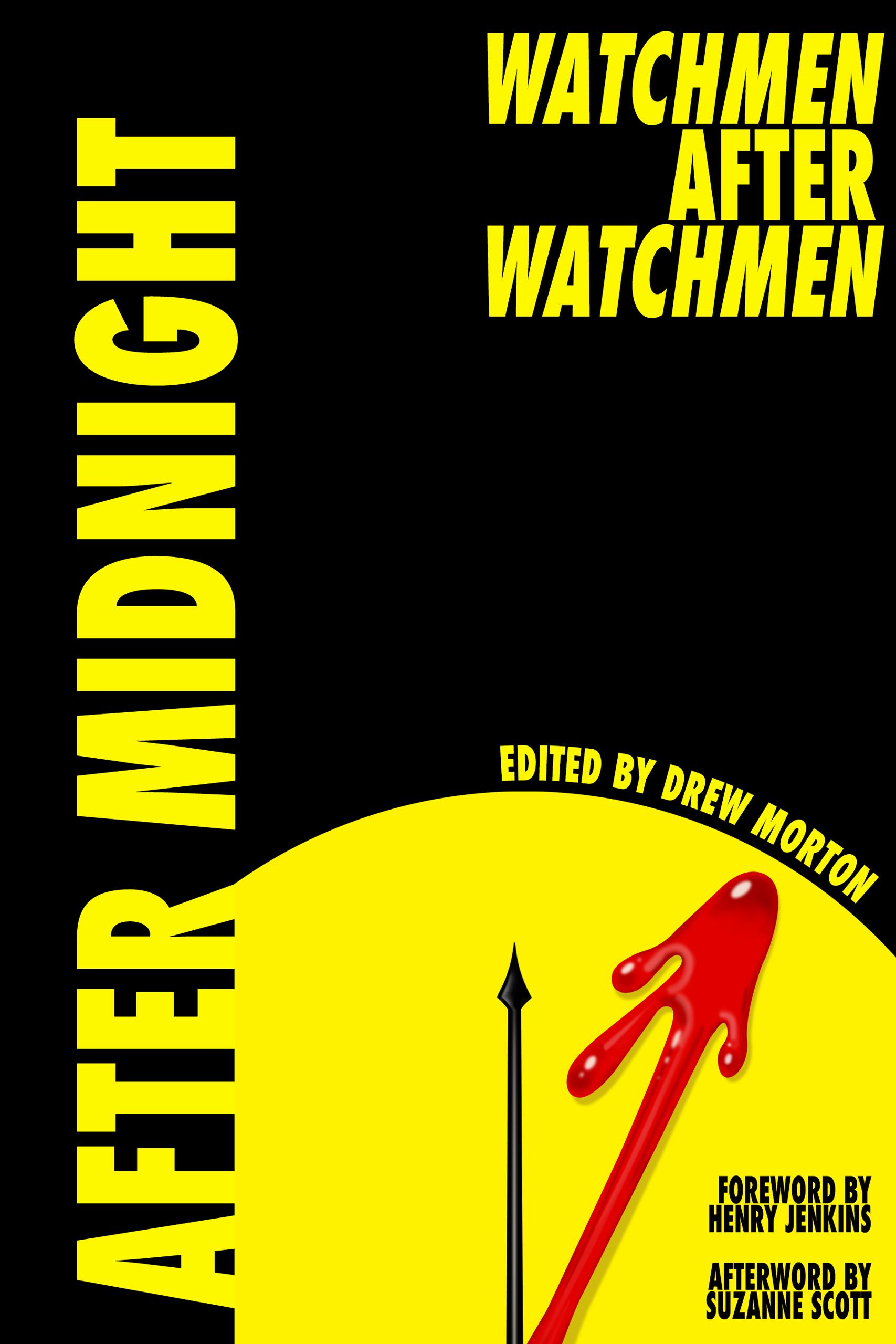
Contributions by Apryl Alexander, Alisia Grace Chase, Brian Faucette, Laura E. Felschow, Lindsay Hallam, Rusty Hatchell, Dru Jeffries, Henry Jenkins, Jeffrey SJ Kirchoff, Curtis Marez, James Denis McGlynn, Brandy Monk-Payton, Chamara Moore, Drew Morton, Mark C. E. Peterson, Jayson Quearry, Zachary J. A. Rondinelli, Suzanne Scott, David Stanley, Sarah Pawlak Stanley, Tracy Vozar, and Chris Yogerst
Alan Moore and Dave Gibbons’s Watchmen fundamentally altered the perception of American comic books and remains one of the medium’s greatest hits. Launched in 1986—“the year that changed comics” for most scholars in comics studies—Watchmen quickly assisted in cementing the legacy that comics were a serious form of literature no longer defined by the Comics Code era of funny animal and innocuous superhero books that appealed mainly to children.
After Midnight: “Watchmen” after “Watchmen” looks specifically at the three adaptations of Moore and Gibbons’s Watchmen—Zack Snyder’s Watchmen film (2009), Geoff Johns’s comic book sequel Doomsday Clock (2017), and Damon Lindelof’s Watchmen series on HBO (2019). Divided into three parts, the anthology considers how the sequels, especially the limited series, have prompted a reevaluation of the original text and successfully harnessed the politics of the contemporary moment into a potent relevancy. The first part considers the various texts through conceptions of adaptation, remediation, and transmedia storytelling. Part two considers the HBO series through its thematic focus on the relationship between American history and African American trauma by analyzing how the show critiques the alt-right, represents intergenerational trauma, illustrates alternative possibilities for Black representation, and complicates our understanding of how the mechanics of the show’s production can impact its politics. Finally, the book’s last section considers the themes of nostalgia and trauma, both firmly rooted in the original Moore and Gibbons series, and how the sequel texts reflect and refract upon those often-intertwined phenomena.
Alan Moore and Dave Gibbons’s Watchmen fundamentally altered the perception of American comic books and remains one of the medium’s greatest hits. Launched in 1986—“the year that changed comics” for most scholars in comics studies—Watchmen quickly assisted in cementing the legacy that comics were a serious form of literature no longer defined by the Comics Code era of funny animal and innocuous superhero books that appealed mainly to children.
After Midnight: “Watchmen” after “Watchmen” looks specifically at the three adaptations of Moore and Gibbons’s Watchmen—Zack Snyder’s Watchmen film (2009), Geoff Johns’s comic book sequel Doomsday Clock (2017), and Damon Lindelof’s Watchmen series on HBO (2019). Divided into three parts, the anthology considers how the sequels, especially the limited series, have prompted a reevaluation of the original text and successfully harnessed the politics of the contemporary moment into a potent relevancy. The first part considers the various texts through conceptions of adaptation, remediation, and transmedia storytelling. Part two considers the HBO series through its thematic focus on the relationship between American history and African American trauma by analyzing how the show critiques the alt-right, represents intergenerational trauma, illustrates alternative possibilities for Black representation, and complicates our understanding of how the mechanics of the show’s production can impact its politics. Finally, the book’s last section considers the themes of nostalgia and trauma, both firmly rooted in the original Moore and Gibbons series, and how the sequel texts reflect and refract upon those often-intertwined phenomena.
Payez facilement par carte, Klarna, Apple Pay ou Google Pay. Pas satisfait ? Vous avez toujours une garantie de remboursement de 14 jours. En savoir plus dans nos conditions. Si vous avez des questions, envoyez-nous un e-mail à hello@memmo.org.
Memmo facilite tes études, où que tu sois dans le monde. On rassemble tes manuels de cours et des outils d'étude intelligents au même endroit : résumés, quiz, podcasts et flashcards. Et il y a Ted, ton compagnon d'étude qui répond à toutes tes questions. Plus de 50 000 étudiants étudient déjà ici – conçu pour t'aider à apprendre plus vite et à moins stresser.
Tu pourrais aussi aimer
Acheter le livre0