
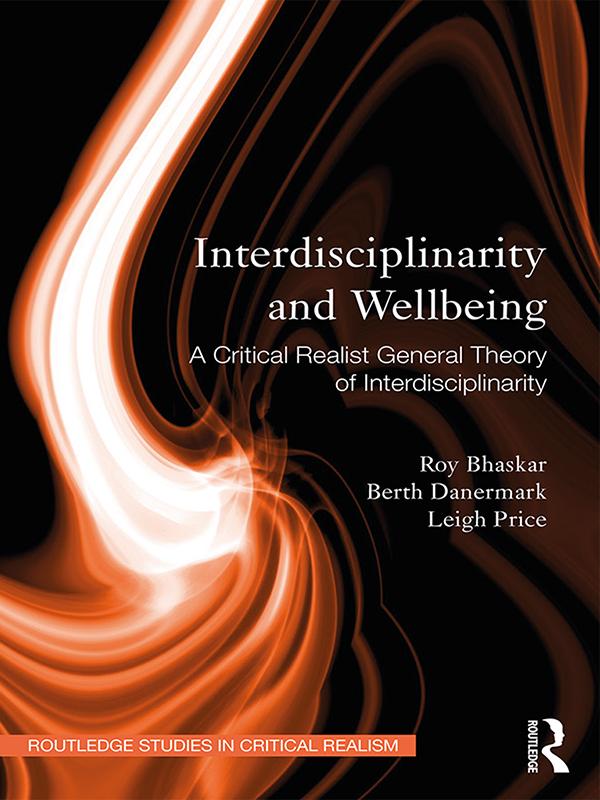
In this book, the authors provide a much-needed general theory of interdisciplinarity and relate it to health/wellbeing research and professional practice. In so doing they make it possible for practitioners of the different disciplines to communicate without contradiction or compromise, resolving the tensions that beset much interdisciplinary work.
Such a general theory is only possible if we assume that there is more to being (ontology) than empirical being (what we can measure directly). Therefore, the unique approach to interdisciplinarity applied in this book starts from ontology, namely that there is a multimechanismicity (a multiplicity of mechanisms) in open systems, and then moves to epistemology. By contrast, the mainstream approach, which fails to acknowledge ontology, is “unserious” and tends to result in a methodological hierarchy, unconducive of interdisciplinarity, in which empiricist science is overtly or tacitly assumed to be the superior version of science.
This book is primarily aimed at those people interested in improving health and wellbeing – such as researchers, policy-makers, educators, and general practitioners. However, it will also be useful to academics engaged in the broader academic debate on interdisciplinary metatheory.
Payez facilement par carte, Klarna, Apple Pay ou Google Pay. Pas satisfait ? Vous avez toujours une garantie de remboursement de 14 jours. En savoir plus dans nos conditions. Si vous avez des questions, envoyez-nous un e-mail à hello@memmo.org.
Memmo facilite tes études, où que tu sois dans le monde. On rassemble tes manuels de cours et des outils d'étude intelligents au même endroit : résumés, quiz, podcasts et flashcards. Et il y a Ted, ton compagnon d'étude qui répond à toutes tes questions. Plus de 50 000 étudiants étudient déjà ici – conçu pour t'aider à apprendre plus vite et à moins stresser.