
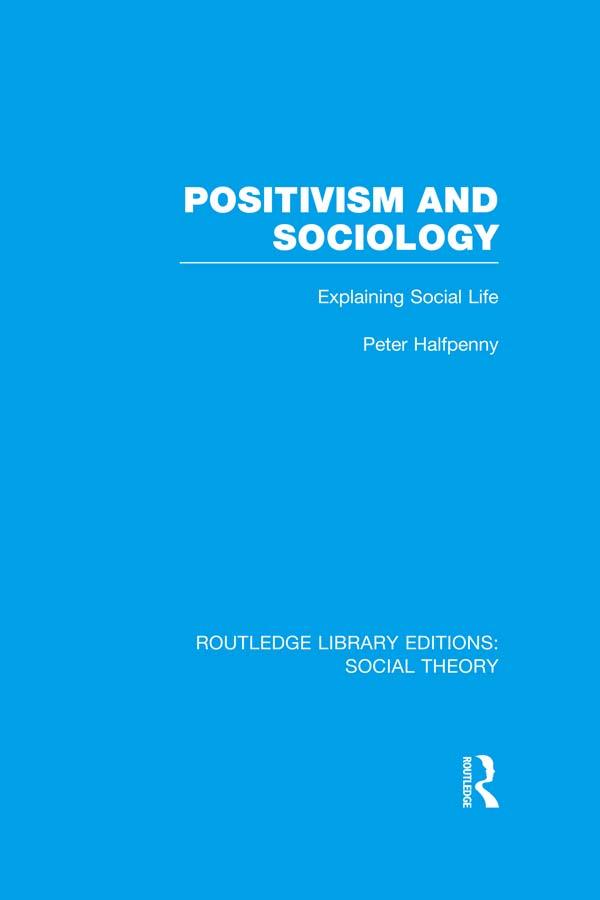
Any serious attempt to explain social life has to come to terms with sociology's positivist legacy. It is a heritage on the one hand from the seventeenth-century political arithmeticians and the later moral statisticians who believed that quantification would provide the basis for a dispassionate analysis of social affairs; and on the other hand from the nineteenth-century post-Enlightenment social philosophers who were eager to develop an empirical science of society that would enable them to control social conduct – just as the physical sciences had provided the knowledge to tame nature. Yet every debate about the relation between positivism and sociology is clouded by the diversity of uses of the term 'positivism' – uses that are so varied that some can pronounce positivism dead while others find it still the vital force that dominates sociology.
The particular merit of Peter Halfpenny's book is that it makes this diversity of uses its central theme. In order to provide a clear basis from which to assess controversial questions about the contribution of the positivist traditions to sociology, the book reviews twelve different important uses of the term 'positivism' that have emerged at different times since the mid-nineteenth century, when Auguste Comte coined both 'positivism' and 'sociology'. This review is conducted by examining the historical development of the two independent roots of modern sociological positivism – positivist philosophy and statistics – and by analysing logical positivist philosophy, which in many ways defined the course of twentieth century philosophy of the social (as well as the natural) sciences.
Payez facilement par carte, Klarna, Apple Pay ou Google Pay. Pas satisfait ? Vous avez toujours une garantie de remboursement de 14 jours. En savoir plus dans nos conditions. Si vous avez des questions, envoyez-nous un e-mail à hello@memmo.org.
Memmo facilite tes études, où que tu sois dans le monde. On rassemble tes manuels de cours et des outils d'étude intelligents au même endroit : résumés, quiz, podcasts et flashcards. Et il y a Ted, ton compagnon d'étude qui répond à toutes tes questions. Plus de 50 000 étudiants étudient déjà ici – conçu pour t'aider à apprendre plus vite et à moins stresser.