
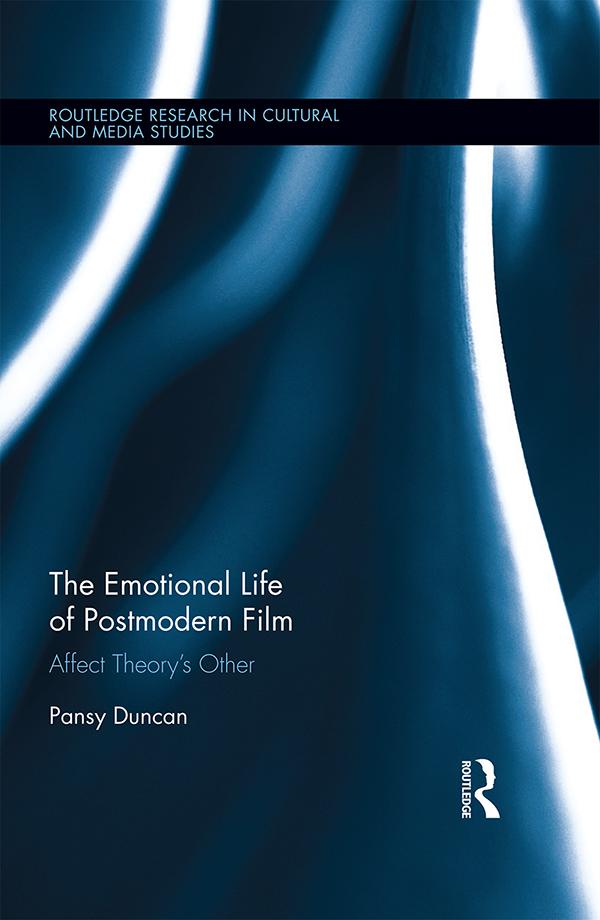
Emotion and Postmodernism: is it possible to imagine an odder couple, stranger bedfellows, less bad company? The Emotional Life of Postmodern Film brings this unlikely pair into sustained dialogue, arguing that the interdisciplinary body of scholarship currently emerging under the rubric of "affect theory" may be unexpectedly enriched by an encounter with the field that has become its critical other. Across a series of radical re-reappraisals of canonical postmodern texts, from Fredric Jameson's Postmodernism to David Cronenberg's Crash, Duncan shows that the same postmodern archive that has proven resistant to strongly subject-based and object-oriented emotions, like anger and sadness, proves all too congenial to a series of idiosyncratic, borderline emotions, from knowingness, fascination and bewilderment to boredom and euphoria. The analysis of these emotions, in turn, promises to shake up scholarly consensus on two key counts. On the one hand, it will restructure our sense of the place and role of emotion in a critical enterprise that has long cast it as the stodgy, subjective sister of a supposedly more critically interesting and politically productive affect. On the other, it will transform our perception of postmodernism as a now-historical aesthetic and theoretical moment, teaching us to acknowledge more explicitly and to name more clearly the emotional life that energizes it.
Payez facilement par carte, Klarna, Apple Pay ou Google Pay. Pas satisfait ? Vous avez toujours une garantie de remboursement de 14 jours. En savoir plus dans nos conditions. Si vous avez des questions, envoyez-nous un e-mail à hello@memmo.org.
Memmo facilite tes études, où que tu sois dans le monde. On rassemble tes manuels de cours et des outils d'étude intelligents au même endroit : résumés, quiz, podcasts et flashcards. Et il y a Ted, ton compagnon d'étude qui répond à toutes tes questions. Plus de 50 000 étudiants étudient déjà ici – conçu pour t'aider à apprendre plus vite et à moins stresser.