
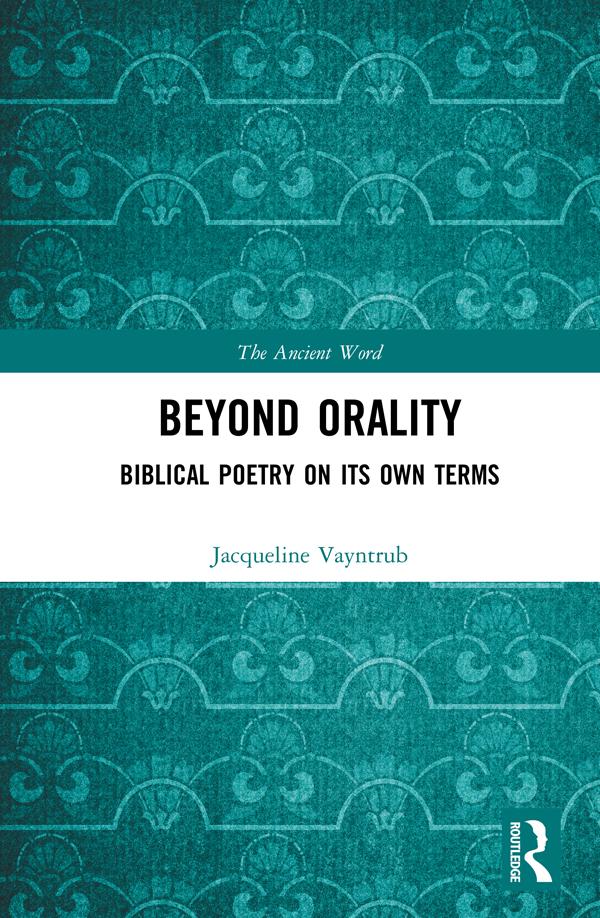
Central to understanding the prophecy and prayer of the Hebrew Bible are the unspoken assumptions that shaped them—their genres. Modern scholars describe these works as “poetry,” but there was no corresponding ancient Hebrew term or concept. Scholars also typically assume it began as “oral literature,” a concept based more in evolutionist assumptions than evidence. Is biblical poetry a purely modern fiction, or is there a more fundamental reason why its definition escapes us?
Beyond Orality: Biblical Poetry on its Own Terms changes the debate by showing how biblical poetry has worked as a mirror, reflecting each era’s own self-image of verbal art. Yet Vayntrub also shows that this problem is rooted in a crucial pattern within the Bible itself: the texts we recognize as “poetry” are framed as powerful and ancient verbal performances, dramatic speeches from the past. The Bible’s creators presented what we call poetry in terms of their own image of the ancient and the oral, and understanding their native theories of Hebrew verbal art gives us a new basis to rethink our own.
Payez facilement par carte, Klarna, Apple Pay ou Google Pay. Pas satisfait ? Vous avez toujours une garantie de remboursement de 14 jours. En savoir plus dans nos conditions. Si vous avez des questions, envoyez-nous un e-mail à hello@memmo.org.
Memmo facilite tes études, où que tu sois dans le monde. On rassemble tes manuels de cours et des outils d'étude intelligents au même endroit : résumés, quiz, podcasts et flashcards. Et il y a Ted, ton compagnon d'étude qui répond à toutes tes questions. Plus de 50 000 étudiants étudient déjà ici – conçu pour t'aider à apprendre plus vite et à moins stresser.