
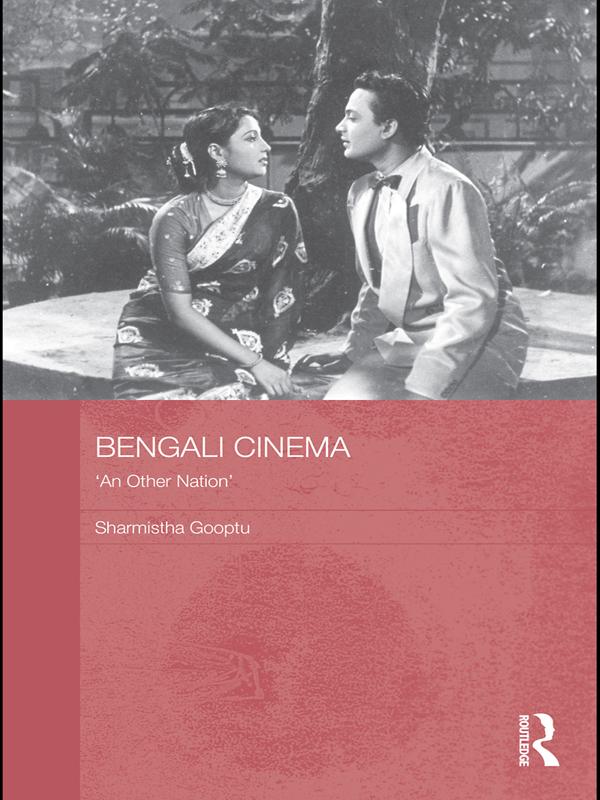
Covering the years spanning cinema’s emergence as a popular form in Bengal in the first half of the twentieth century, this book examines the main genres and trends produced by this cinema, and leads up to Bengali cinema’s last phase of transition in the 1980s. Arguing that Bengali cinema has been a key economic and social institution, the author highlights that the Bengali filmic imaginary existed over and above the imaginary of the Indian nation.
This book argues that a definitive history of Bengali cinema presents an alternative understanding to the currently influential notion of the Hindi film as the ‘Indian’ or ‘national’ cinema. It suggests that the Bengali cinema presents a history which brings to the fore the deeply contested terrain of ‘national’ cinema, and shows the creation of the ‘alternative imaginary’ of the Bengali film. The author indicates that the case of the Bengali cinema demonstrates the emergence of a public domain that set up a definitive discourse of difference with respect to the ‘all-India’ Hindi film, popularly classified as Bollywood cinema, and which pre-empted its subsumption within the more pervasive culture of the Bombay Hindi cinema. As the first comprehensive historical work on Bengali cinema, this book makes a significant contribution to both Film and Cultural Studies and South Asian Studies in general.
Payez facilement par carte, Klarna, Apple Pay ou Google Pay. Pas satisfait ? Vous avez toujours une garantie de remboursement de 14 jours. En savoir plus dans nos conditions. Si vous avez des questions, envoyez-nous un e-mail à hello@memmo.org.
Memmo facilite tes études, où que tu sois dans le monde. On rassemble tes manuels de cours et des outils d'étude intelligents au même endroit : résumés, quiz, podcasts et flashcards. Et il y a Ted, ton compagnon d'étude qui répond à toutes tes questions. Plus de 50 000 étudiants étudient déjà ici – conçu pour t'aider à apprendre plus vite et à moins stresser.