
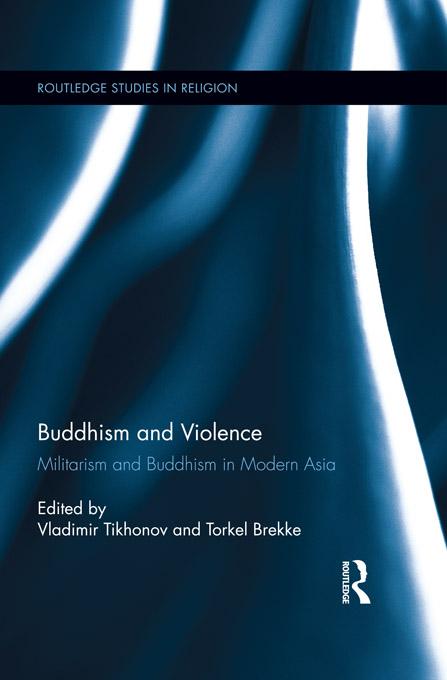
It is generally accepted in the West that Buddhism is a ‘peaceful’ religion. The Western public tends to assume that the doctrinal rejection of violence in Buddhism would make Buddhist pacifists, and often expects Buddhist societies or individual Asian Buddhists to conform to the modern Western standards of ‘peaceful’ behavior. This stereotype – which may well be termed ‘positive Orientalism,’ since it is based on assumption that an ‘Oriental’ religion would be more faithful to its original non-violent teachings than Western Christianity – has been periodically challenged by enthusiastic acquiescence by monastic Buddhism to the most brutal sorts of warfare.
This volume demolishes this stereotype, and produces instead a coherent, nuanced account on the modern Buddhist attitudes towards violence and warfare, which take into consideration both doctrinal logic of Buddhism and the socio-political situation in Asian Buddhist societies. The chapters in this book offer a deeper analysis of ‘Buddhist militarism’ and Buddhist attitudes towards violence than previous volumes, grounded in an awareness of Buddhist doctrines and the recent history of nationalism, as well as the role Buddhism plays in constructions of national identity. The international team of contributors includes scholars from Thailand, Japan, and Korea.
Payez facilement par carte, Klarna, Apple Pay ou Google Pay. Pas satisfait ? Vous avez toujours une garantie de remboursement de 14 jours. En savoir plus dans nos conditions. Si vous avez des questions, envoyez-nous un e-mail à hello@memmo.org.
Memmo facilite tes études, où que tu sois dans le monde. On rassemble tes manuels de cours et des outils d'étude intelligents au même endroit : résumés, quiz, podcasts et flashcards. Et il y a Ted, ton compagnon d'étude qui répond à toutes tes questions. Plus de 50 000 étudiants étudient déjà ici – conçu pour t'aider à apprendre plus vite et à moins stresser.