
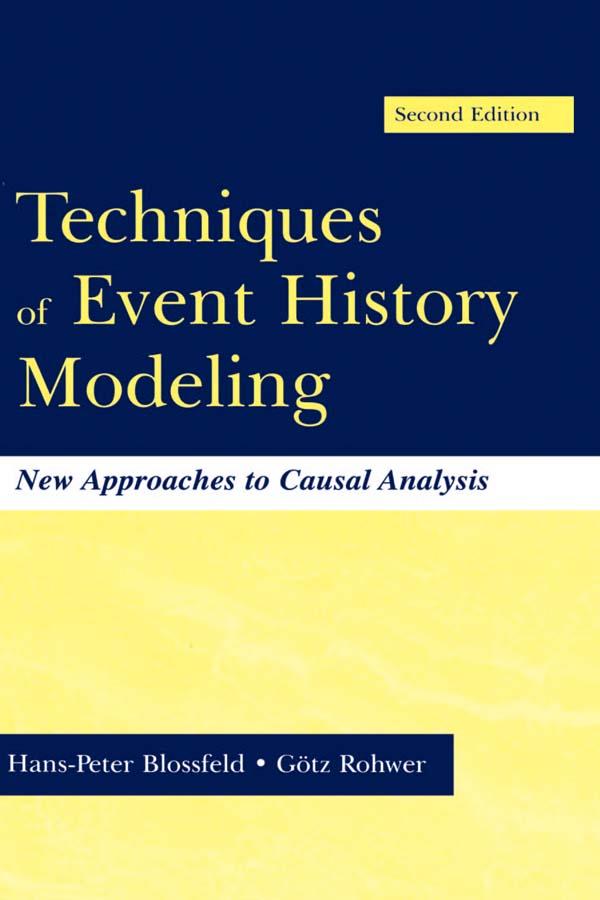
Including new developments and publications which have appeared since the publication of the first edition in 1995, this second edition:
*gives a comprehensive introductory account of event history modeling techniques and their use in applied research in economics and the social sciences;
*demonstrates that event history modeling is a major step forward in causal analysis. To do so the authors show that event history models employ the time-path of changes in states and relate changes in causal variables in the past to changes in discrete outcomes in the future; and
*introduces the reader to the computer program Transition Data Analysis (TDA). This software estimates the sort of models most frequently used with longitudinal data, in particular, discrete-time and continuous-time event history data.
Techniques of Event History Modeling can serve as a student textbook in the fields of statistics, economics, the social sciences, psychology, and the political sciences. It can also be used as a reference for scientists in all fields of research.
Payez facilement par carte, Klarna, Apple Pay ou Google Pay. Pas satisfait ? Vous avez toujours une garantie de remboursement de 14 jours. En savoir plus dans nos conditions. Si vous avez des questions, envoyez-nous un e-mail à hello@memmo.org.
Memmo facilite tes études, où que tu sois dans le monde. On rassemble tes manuels de cours et des outils d'étude intelligents au même endroit : résumés, quiz, podcasts et flashcards. Et il y a Ted, ton compagnon d'étude qui répond à toutes tes questions. Plus de 50 000 étudiants étudient déjà ici – conçu pour t'aider à apprendre plus vite et à moins stresser.