
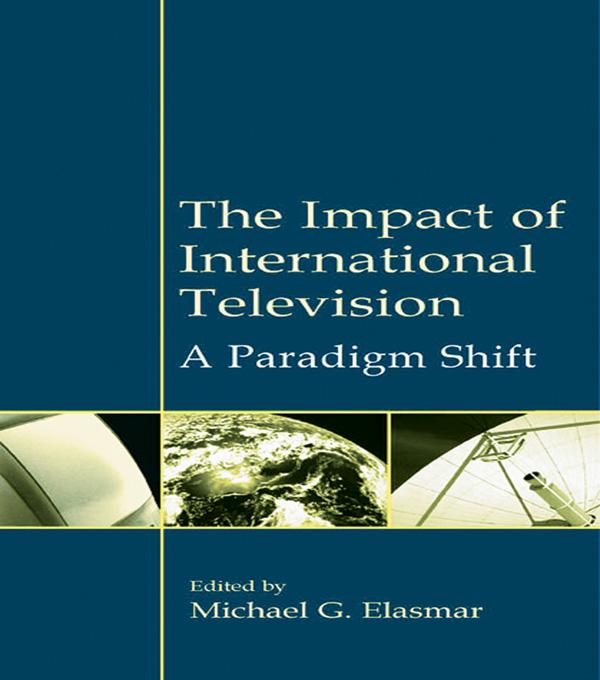
For several decades, cultural imperialism has been the dominant paradigm for conceptualizing, labeling, predicting, and explaining the effects of international television. It has been used as an unchallenged premise for numerous essays on the topic of imported television influence, despite the fact that the assumption of strong cultural influence is not necessarily reflected in the body of research that exists within this field of study. In The Impact of International Television: A Paradigm Shift, editor Michael G. Elasmar and his contributors challenge the dominant paradigm of cultural imperialism, and offer an alternative paradigm with which to evaluate international or crossborder message influence.
In this volume, Elasmar has collected original research from leading scholars working in the area of crossborder media influence, and contributes his own meta-analysis to examine what research findings actually show on the influences of crossborder messages. The contributions included here illustrate points, such as: the contentions of cultural imperialism and the context in which its assumptions emerged and developed; the complexities of the relationship between exposure to foreign television and its subsequent effects on local audience members; the applicability of quantitative methods to a topic commonly tackled using argumentation, critical theory, and other qualitative approaches; and the difficulty of achieving strong and homogenous effects.
In bringing together the work of independent researchers, The Impact of International Television: A Paradigm Shift bridges over 40 years of research efforts focused on imported television influence, the results of which, as a whole, challenge the de facto strong and homogenous effects assumed by those who support the paradigm of cultural imperialism. The volume sets a theory-driven agenda of research and offers an alternative paradigm for the new generation of researchers interested in international media effects. As such, the volume is intended for scholars, researchers, and students in international and intercultural communication, cross-cultural communication, mass communication, media effects, media and society, and related areas. It will also be of great interest to academics in international relations, cross-cultural and social psychology, intergroup and international relations, international public opinion, and peace studies.
Payez facilement par carte, Klarna, Apple Pay ou Google Pay. Pas satisfait ? Vous avez toujours une garantie de remboursement de 14 jours. En savoir plus dans nos conditions. Si vous avez des questions, envoyez-nous un e-mail à hello@memmo.org.
Memmo facilite tes études, où que tu sois dans le monde. On rassemble tes manuels de cours et des outils d'étude intelligents au même endroit : résumés, quiz, podcasts et flashcards. Et il y a Ted, ton compagnon d'étude qui répond à toutes tes questions. Plus de 50 000 étudiants étudient déjà ici – conçu pour t'aider à apprendre plus vite et à moins stresser.