
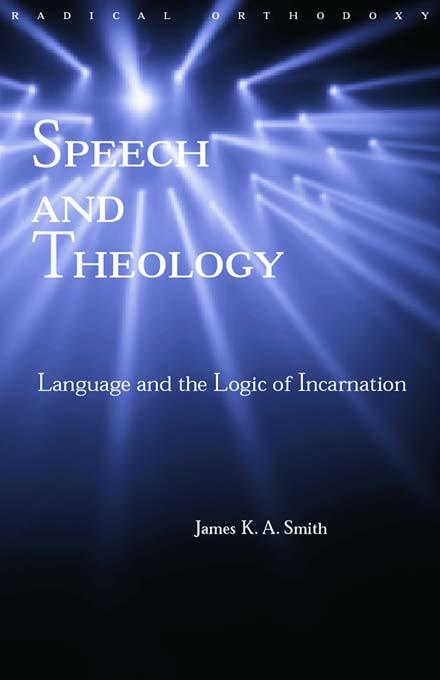
God is infinite, but language finite; thus speech would seem to condemn Him to finitude. In speaking of God, would the theologian violate divine transcendence by reducing God to immanence, or choose, rather, to remain silent? At stake in this argument is a core problem of the conditions of divine revelation. How, in terms of language and the limitations of human understanding, can transcendence ever be made known? Does its very appearance not undermine its transcendence, its condition of unknowability?
Speech and Theology posits that the paradigm for the encounter between the material and the divine, or the immanent and transcendent, is found in the Incarnation: God's voluntary self-immersion in the human world as an expression of His love for His creation. By this key act of grace, hinged upon Christs condescension to human finitude, philosophy acquires the means not simply to speak of perfection, which is to speak theologically, but to bridge the gap between word and thing in general sense.
Payez facilement par carte, Klarna, Apple Pay ou Google Pay. Pas satisfait ? Vous avez toujours une garantie de remboursement de 14 jours. En savoir plus dans nos conditions. Si vous avez des questions, envoyez-nous un e-mail à hello@memmo.org.
Memmo facilite tes études, où que tu sois dans le monde. On rassemble tes manuels de cours et des outils d'étude intelligents au même endroit : résumés, quiz, podcasts et flashcards. Et il y a Ted, ton compagnon d'étude qui répond à toutes tes questions. Plus de 50 000 étudiants étudient déjà ici – conçu pour t'aider à apprendre plus vite et à moins stresser.