
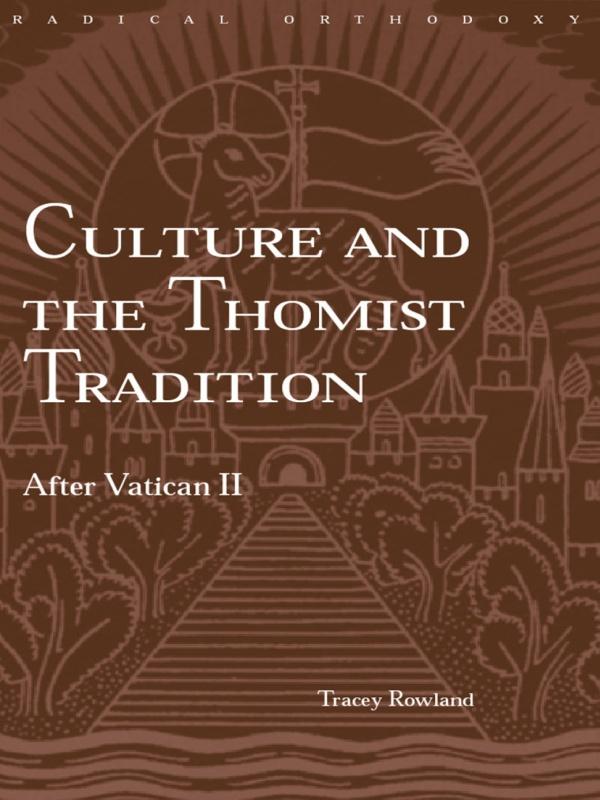
Thomism's influence upon the development of Catholicism is difficult to overestimate - but how secure is its grip on the challenges that face contemporary society? Culture and the Thomist Tradition examines the crisis of Thomism today as thrown into relief by Vatican II, the twenty-first ecumenical council of the Roman Catholic Church. Following the Church's declarations on culture in the document Gaudium et spes - the Pastoral Constitution on the Church in the Modern World - it was widely presumed that a mandate had been given for transposing ecclesiastical culture into the idioms of modernity. But, says Tracey Rowland, such an understanding is not only based on a facile reading of the Conciliar documents, but was made possible by Thomism's own failure to demonstrate a workable theology of culture that might guide the Church through such transpositions.
A Thomism that fails to specify the precise rôle of culture in moral fomration is problematice in a multicultural age, where Christians are exposed to a complex matrix of institutions and traditions both theistic and secular. The ambivalence of the Thomist tradition to modernity, and modern conceptions of rationality, also impedes its ability to successfully engage with the arguments of rivial traditions. Must a genuinely progressive Thomism learn to accomodate modernity? In opposition to such a stance, and in support of those who have resisted the trend in post-Conciliarliturgy to mimic the modernistic forms of mass culture, Culture and the Thomist Tradition musters a synthesis of the theological critiques of modernity to be found in the works of Alasdair MacIntyre, scholars of the international 'Communio' project and the Radical Orthodoxy circle. This synthesis, intended as a post-modern Augustinian Thomism, provides an account of the rôle of culture, memory and narrative tradition in the formation of intellectual and moral character. Re-evaluating the outcome of Vatican II, and forming the basis of a much-needed Thomist theology of culture, the book argues that the anti-beauty orientation of mass culture acts as a barrier to the theological virtue of hope, and ultimately fosters despair and atheism.
Payez facilement par carte, Klarna, Apple Pay ou Google Pay. Pas satisfait ? Vous avez toujours une garantie de remboursement de 14 jours. En savoir plus dans nos conditions. Si vous avez des questions, envoyez-nous un e-mail à hello@memmo.org.
Memmo facilite tes études, où que tu sois dans le monde. On rassemble tes manuels de cours et des outils d'étude intelligents au même endroit : résumés, quiz, podcasts et flashcards. Et il y a Ted, ton compagnon d'étude qui répond à toutes tes questions. Plus de 50 000 étudiants étudient déjà ici – conçu pour t'aider à apprendre plus vite et à moins stresser.