
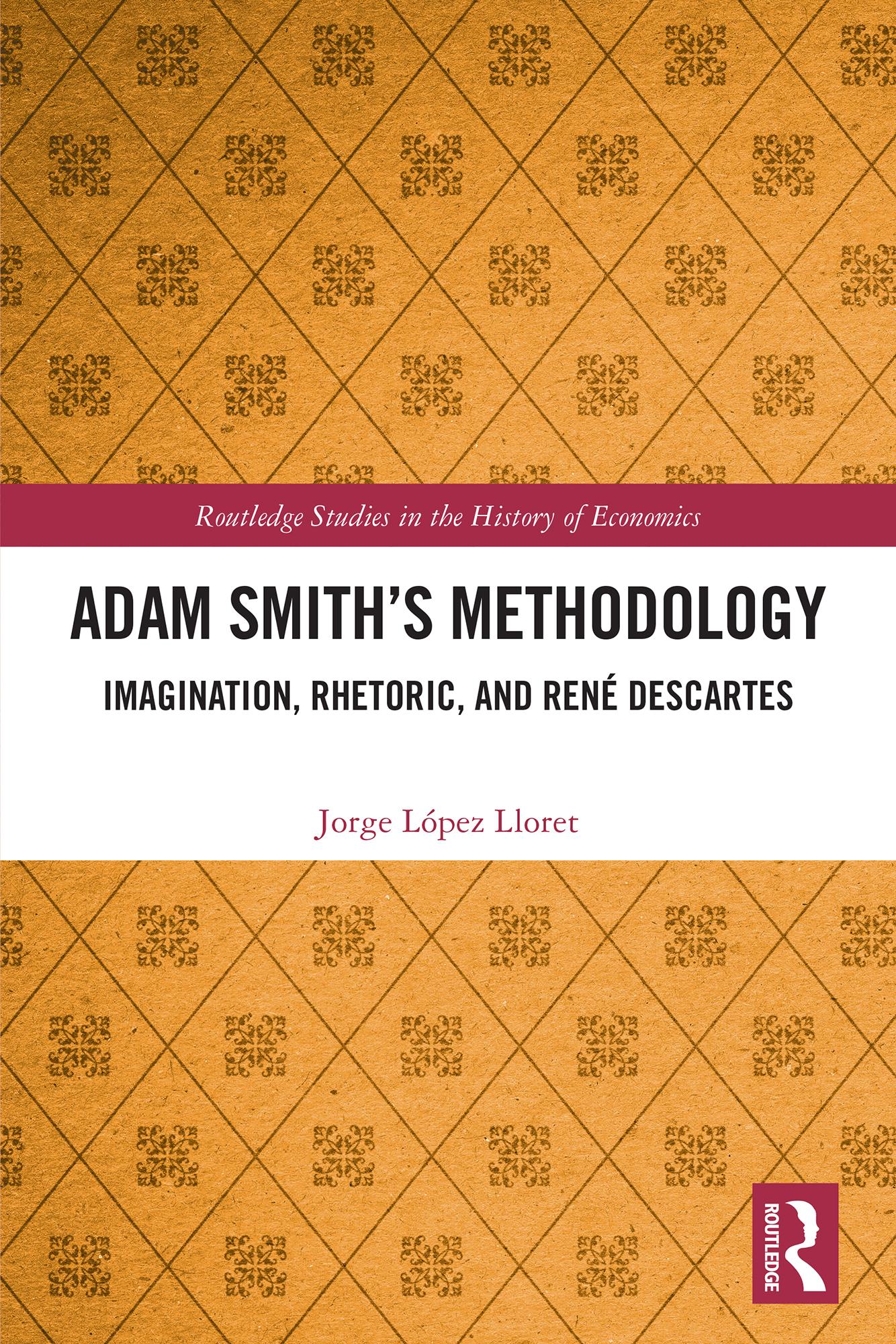
Most previous studies of Adam Smith’s methodology, with a few exceptions, have placed considerable emphasis on the undeniable influence of Newtonian physics and Humean empiricism.
This book argues that other sources are at least as important: Smith’s own didactic rhetoric and the methodological writings of René Descartes. Smith began his public life in 1748, lecturing on rhetoric in Edinburgh. During this time he also wrote a history of astronomy, tracing its development from the age of mythical thought to Descartes (later incorporating Newton’s ideas). In his History of Astronomy, he was less concerned with the truth value of theories than with their ability to quiet the human imagination by systematically combining numerous phenomena under a few unifying principles. In his lectures on rhetoric, he considered this approach to be the best method of didactic exposition. In both cases, he attached the greatest importance to one of the authors he cited most often between 1748 and 1763, Descartes. As such, Descartes and rhetoric were central to the young Smith’s thinking prior to the publication of The Theory of Moral Sentiments. Consequently, any methodological examination of Smith’s published works must be framed as a question of didactic exposition seen through a Cartesian lens.
This book will appeal particularly to historians of philosophy and economic theory, as well as to scholars of Adam Smith’s life and work.
Payez facilement par carte, Klarna, Apple Pay ou Google Pay. Pas satisfait ? Vous avez toujours une garantie de remboursement de 14 jours. En savoir plus dans nos conditions. Si vous avez des questions, envoyez-nous un e-mail à hello@memmo.org.
Memmo facilite tes études, où que tu sois dans le monde. On rassemble tes manuels de cours et des outils d'étude intelligents au même endroit : résumés, quiz, podcasts et flashcards. Et il y a Ted, ton compagnon d'étude qui répond à toutes tes questions. Plus de 50 000 étudiants étudient déjà ici – conçu pour t'aider à apprendre plus vite et à moins stresser.