
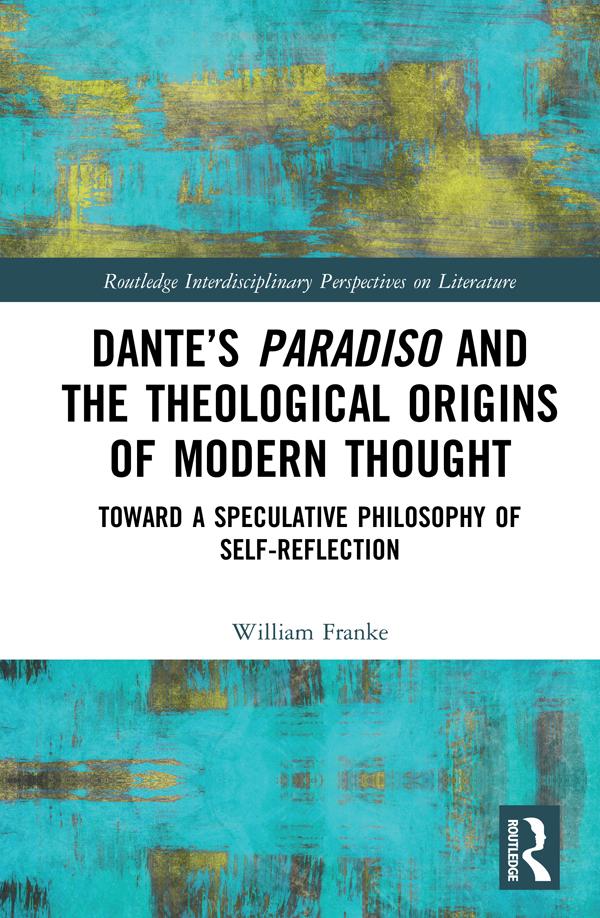
Self-reflection, as the hallmark of the modern age, originates more profoundly with Dante than with Descartes. This book rewrites modern intellectual history, taking Dante’s lyrical language in Paradiso as enacting a Trinitarian self-reflexivity that gives a theological spin to the birth of the modern subject already with the Troubadours. The ever more intense self-reflexivity that has led to our contemporary secular world and its technological apocalypse can lead also to the poetic vision of other worlds such as those experienced by Dante. Facing the same nominalist crisis as Duns Scotus, his exact contemporary and the precursor of scientific method, Dante’s thought and work indicate an alternative modernity along the path not taken. This other way shows up in Nicholas of Cusa’s conjectural science and in Giambattista Vico’s new science of imagination as alternatives to the exclusive reign of positive empirical science. In continuity with Dante’s vision, they contribute to a reappropriation of self-reflection for the humanities.
Payez facilement par carte, Klarna, Apple Pay ou Google Pay. Pas satisfait ? Vous avez toujours une garantie de remboursement de 14 jours. En savoir plus dans nos conditions. Si vous avez des questions, envoyez-nous un e-mail à hello@memmo.org.
Memmo facilite tes études, où que tu sois dans le monde. On rassemble tes manuels de cours et des outils d'étude intelligents au même endroit : résumés, quiz, podcasts et flashcards. Et il y a Ted, ton compagnon d'étude qui répond à toutes tes questions. Plus de 50 000 étudiants étudient déjà ici – conçu pour t'aider à apprendre plus vite et à moins stresser.