
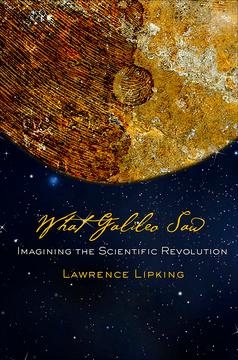
The Scientific Revolution of the seventeenth century has often been called a decisive turning point in human history. It represents, for good or ill, the birth of modern science and modern ways of viewing the world. In What Galileo Saw, Lawrence Lipking offers a new perspective on how to understand what happened then, arguing that artistic imagination and creativity as much as rational thought played a critical role in creating new visions of science and in shaping stories about eye-opening discoveries in cosmology, natural history, engineering, and the life sciences.
When Galileo saw the face of the Moon and the moons of Jupiter, Lipking writes, he had to picture a cosmos that could account for them. Kepler thought his geometry could open a window into the mind of God. Francis Bacon's natural history envisioned an order of things that would replace the illusions of language with solid evidence and transform notions of life and death. Descartes designed a hypothetical "Book of Nature" to explain how everything in the universe was constructed. Thomas Browne reconceived the boundaries of truth and error. Robert Hooke, like Leonardo, was both researcher and artist; his schemes illuminate the microscopic and the macrocosmic. And when Isaac Newton imagined nature as a coherent and comprehensive mathematical system, he redefined the goals of science and the meaning of genius.
What Galileo Saw bridges the divide between science and art; it brings together Galileo and Milton, Bacon and Shakespeare. Lipking enters the minds and the workshops where the Scientific Revolution was fashioned, drawing on art, literature, and the history of science to reimagine how perceptions about the world and human life could change so drastically, and change forever.
Payez facilement par carte, Klarna, Apple Pay ou Google Pay. Pas satisfait ? Vous avez toujours une garantie de remboursement de 14 jours. En savoir plus dans nos conditions. Si vous avez des questions, envoyez-nous un e-mail à hello@memmo.org.
Memmo facilite tes études, où que tu sois dans le monde. On rassemble tes manuels de cours et des outils d'étude intelligents au même endroit : résumés, quiz, podcasts et flashcards. Et il y a Ted, ton compagnon d'étude qui répond à toutes tes questions. Plus de 50 000 étudiants étudient déjà ici – conçu pour t'aider à apprendre plus vite et à moins stresser.