
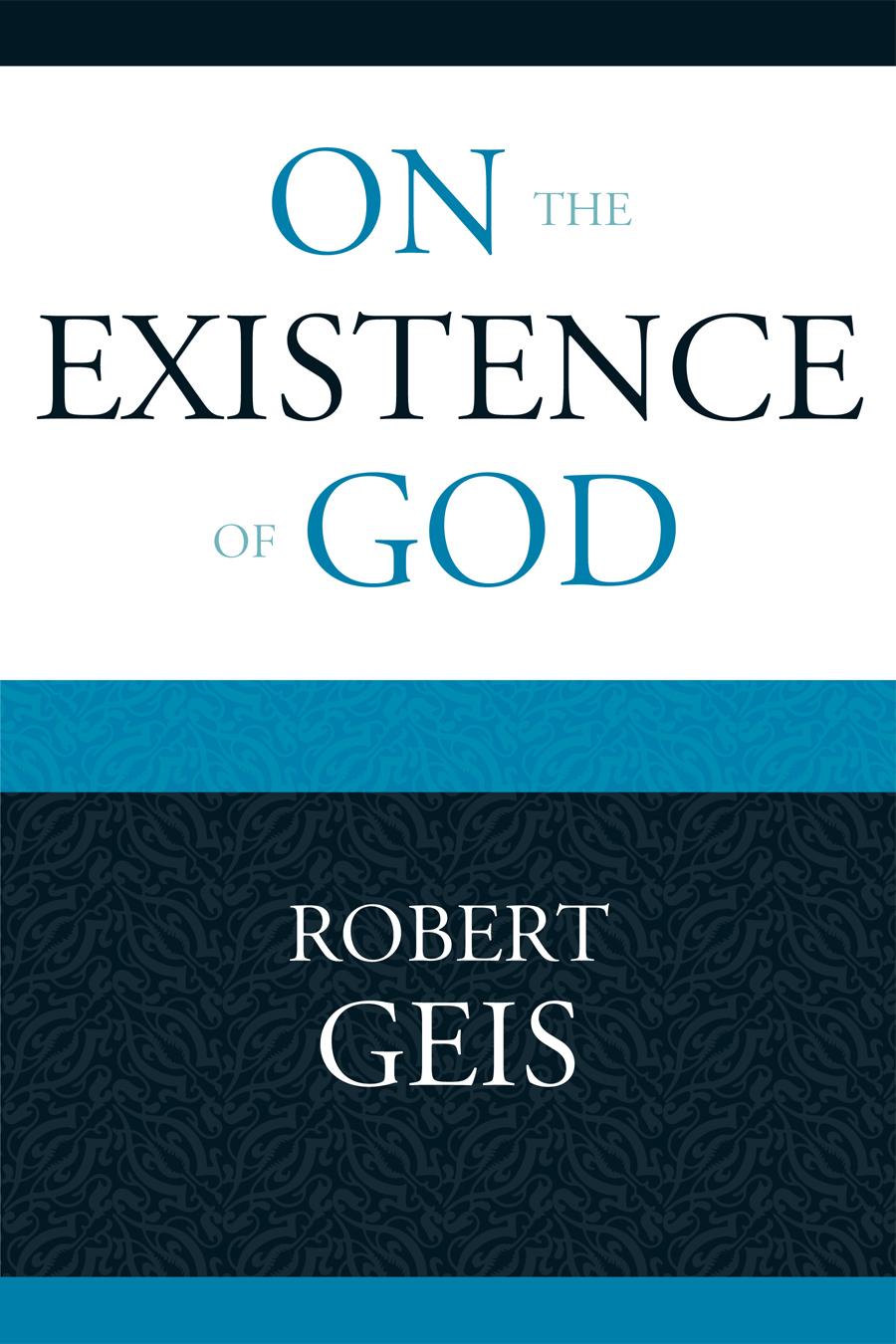
The existence of God raises many questions. Geis' work addresses queries that arise from the gratuitous claims of empiricism in Hume, unfounded assumptions in Kant, presumptions of science, and the improbabilities it identifies in Darwinism. By focusing on number and proportion as intrinsic to material and atomic constituency, any argument from chance as instrumental to the cosmos' emergence and sustainability becomes invalidated. The arguments from contingency and the nature of intellection provide more clarity than the ratio Anselmi for acknowledging a transcendent causality, taking the reader to the problem of evil and present-day nihilism. These concepts present great, but not insuperable, difficulty for theism. Geis argues that evil, when one uses it as a means to the betterment of oneself and the world, takes on the rôle commensurate with the doctrine of an omnibenevolent deity. Accordingly, one can use evil as a means to a greater understanding of God, Providence, and eternal destiny.
Payez facilement par carte, Klarna, Apple Pay ou Google Pay. Pas satisfait ? Vous avez toujours une garantie de remboursement de 14 jours. En savoir plus dans nos conditions. Si vous avez des questions, envoyez-nous un e-mail à hello@memmo.org.
Memmo facilite tes études, où que tu sois dans le monde. On rassemble tes manuels de cours et des outils d'étude intelligents au même endroit : résumés, quiz, podcasts et flashcards. Et il y a Ted, ton compagnon d'étude qui répond à toutes tes questions. Plus de 50 000 étudiants étudient déjà ici – conçu pour t'aider à apprendre plus vite et à moins stresser.