
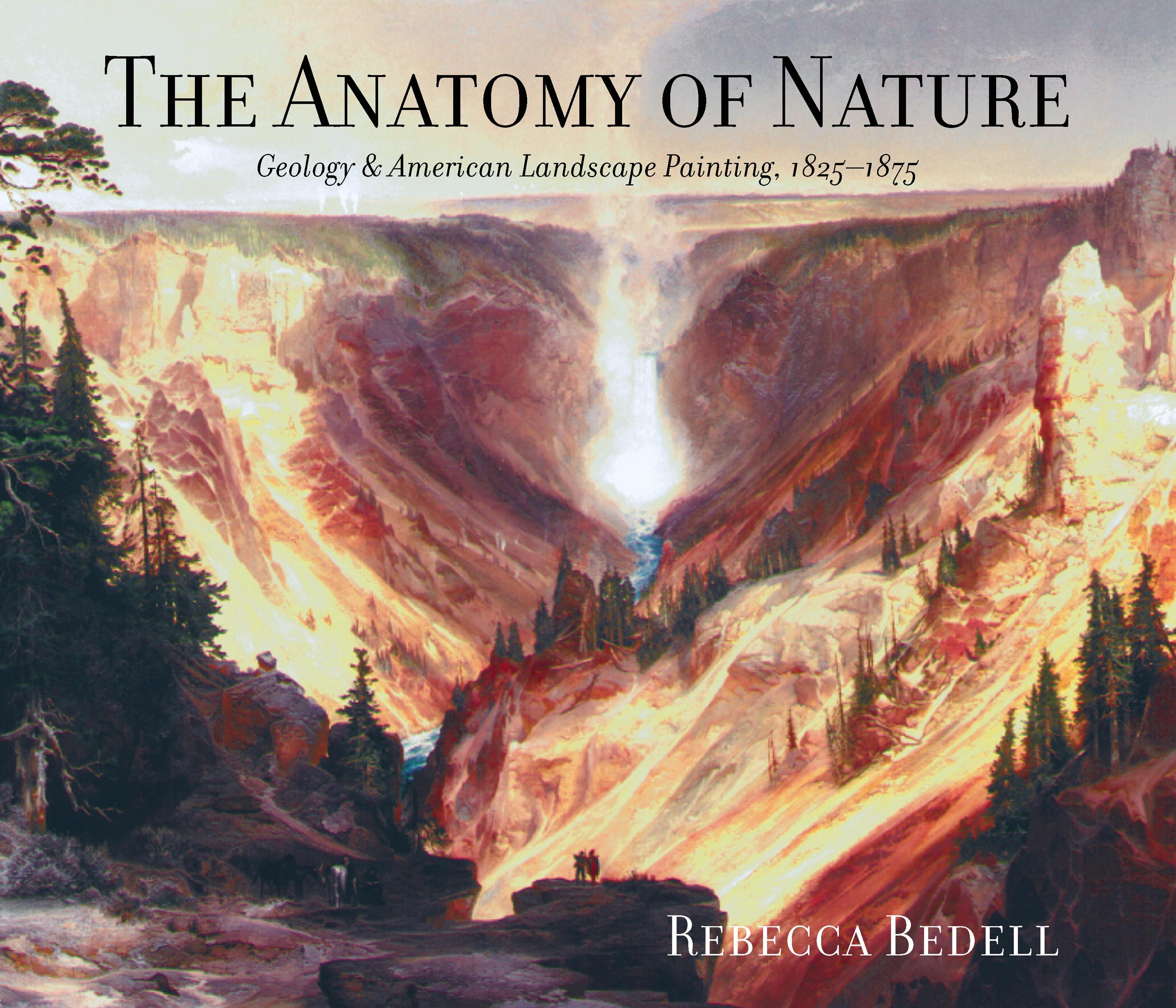
An illuminating account of the interplay between science, religion, and nature in nineteenth-century landscape painting
Geology was in vogue in nineteenth-century America. People crowded lecture halls to hear geologists speak, and parlor mineral cabinets signaled social respectability and intellectual engagement. This was also the heyday of the Hudson River School, and many prominent landscape painters avidly studied geology. Thomas Cole, Asher Durand, Frederic Church, John F. Kensett, William Stanley Haseltine, Thomas Moran, and other artists read scientific texts, participated in geological surveys, and carried rock hammers into the field to collect fossils and mineral specimens. As they crafted their paintings, these artists drew on their geological knowledge to shape new vocabularies of landscape elements resonant with moral, spiritual, and intellectual ideas.
Rebecca Bedell contributes to current debates about the relationship among art, science, and religion by exploring this phenomenon. She shows that at a time when many geologists sought to disentangle their science from religion, American artists generally sidestepped the era's more materialist science, particularly Darwinism. They favored a conservative, Christianized geology that promoted scientific study as a way to understand God. Their art was both shaped by and sought to preserve this threatened version of the science. And, through their art, they advanced consequential social developments, including westward expansion, scenic tourism, the emergence of a therapeutic culture, and the creation of a coherent and cohesive national identity.
This major study of the Hudson River School offers an unprecedented account of the role of geology in nineteenth-century landscape painting. It yields fresh insights into some of the most influential works of American art and enriches our understanding of the relationship between art and nature, and between science and religion, in the nineteenth century. It will draw a broad audience of art historians, Americanists, historians of science, and readers interested in the American natural landscape.
Payez facilement par carte, Klarna, Apple Pay ou Google Pay. Pas satisfait ? Vous avez toujours une garantie de remboursement de 14 jours. En savoir plus dans nos conditions. Si vous avez des questions, envoyez-nous un e-mail à hello@memmo.org.
Memmo facilite tes études, où que tu sois dans le monde. On rassemble tes manuels de cours et des outils d'étude intelligents au même endroit : résumés, quiz, podcasts et flashcards. Et il y a Ted, ton compagnon d'étude qui répond à toutes tes questions. Plus de 50 000 étudiants étudient déjà ici – conçu pour t'aider à apprendre plus vite et à moins stresser.