
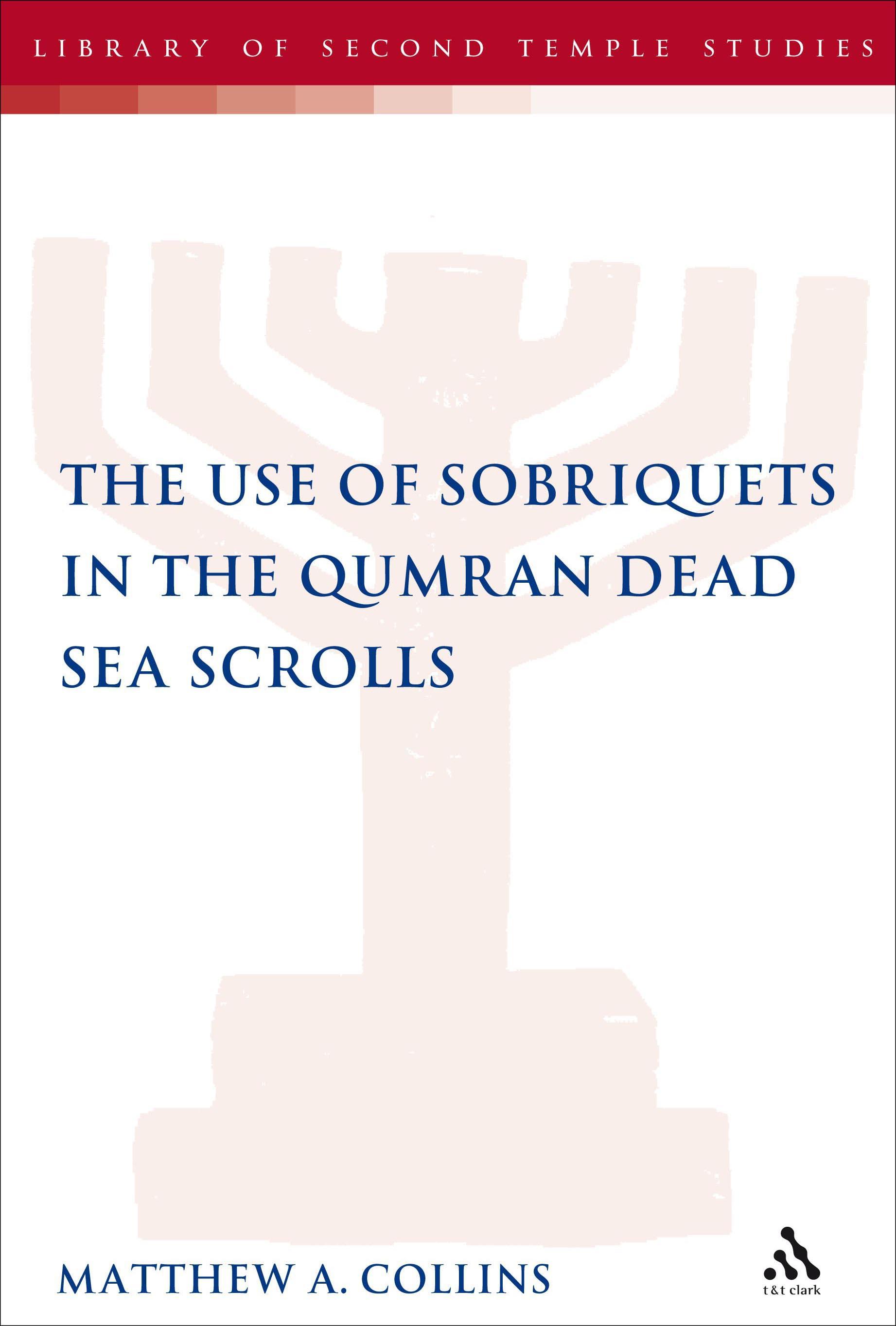
This book constitutes an examination of key sobriquets found among the Qumran Dead Sea Scrolls. Its primary focus is literary rather than historical and concentrates on the function of the sobriquets as labels utilised positively or negatively within the sectarian compositions. Noting the presence of 'standard' and 'variant' forms of these designations, this study examines the differing form and function of the sobriquets across the range of texts in which they appear. More specifically, it attempts to demonstrate that over time they underwent a developmental process, changing in form and perhaps denotation.
Adopting a chronological schema that posits a Formative, Early and Late Sectarian Period, and concentrating on the sobriquets 'the Teacher of Righteousness' and 'the Spouter of the Lie', this investigation observes a development from contextualised scriptural typologies towards titular forms constituting discrete elements of sectarian terminology. A more general evolutionary trend towards a definite ('standard') form is also highlighted, with so-called variants representing earlier stages in this process (further demonstrated by means of a supplementary case study involving the sobriquet, 'the Seekers of Smooth Things').Comparison of these results with sociological insights, drawing upon the sociology of deviance and 'labelling theory', suggests that this phenomenon can be understood against a wider context of labelling practices. Thus it is demonstrated that the sobriquets function as tools for labelling deviance and affirming positive counterparts. Furthermore, it is suggested that the move towards definite titular forms reflects a process of role engulfment, increased prototypically and the ultimate acquisition of 'master status'.
Adopting a chronological schema that posits a Formative, Early and Late Sectarian Period, and concentrating on the sobriquets 'the Teacher of Righteousness' and 'the Spouter of the Lie', this investigation observes a development from contextualised scriptural typologies towards titular forms constituting discrete elements of sectarian terminology. A more general evolutionary trend towards a definite ('standard') form is also highlighted, with so-called variants representing earlier stages in this process (further demonstrated by means of a supplementary case study involving the sobriquet, 'the Seekers of Smooth Things').Comparison of these results with sociological insights, drawing upon the sociology of deviance and 'labelling theory', suggests that this phenomenon can be understood against a wider context of labelling practices. Thus it is demonstrated that the sobriquets function as tools for labelling deviance and affirming positive counterparts. Furthermore, it is suggested that the move towards definite titular forms reflects a process of role engulfment, increased prototypically and the ultimate acquisition of 'master status'.
Pages: 288
Catégorie: Religion & Teologi
e-ISBN: 9780567652454
Poids d'expédition: 1.2 kg
Expédié sous: 1-2 jours
Payez facilement par carte, Klarna, Apple Pay ou Google Pay. Pas satisfait ? Vous avez toujours une garantie de remboursement de 14 jours. En savoir plus dans nos conditions. Si vous avez des questions, envoyez-nous un e-mail à hello@memmo.org.
Memmo facilite tes études, où que tu sois dans le monde. On rassemble tes manuels de cours et des outils d'étude intelligents au même endroit : résumés, quiz, podcasts et flashcards. Et il y a Ted, ton compagnon d'étude qui répond à toutes tes questions. Plus de 50 000 étudiants étudient déjà ici – conçu pour t'aider à apprendre plus vite et à moins stresser.