
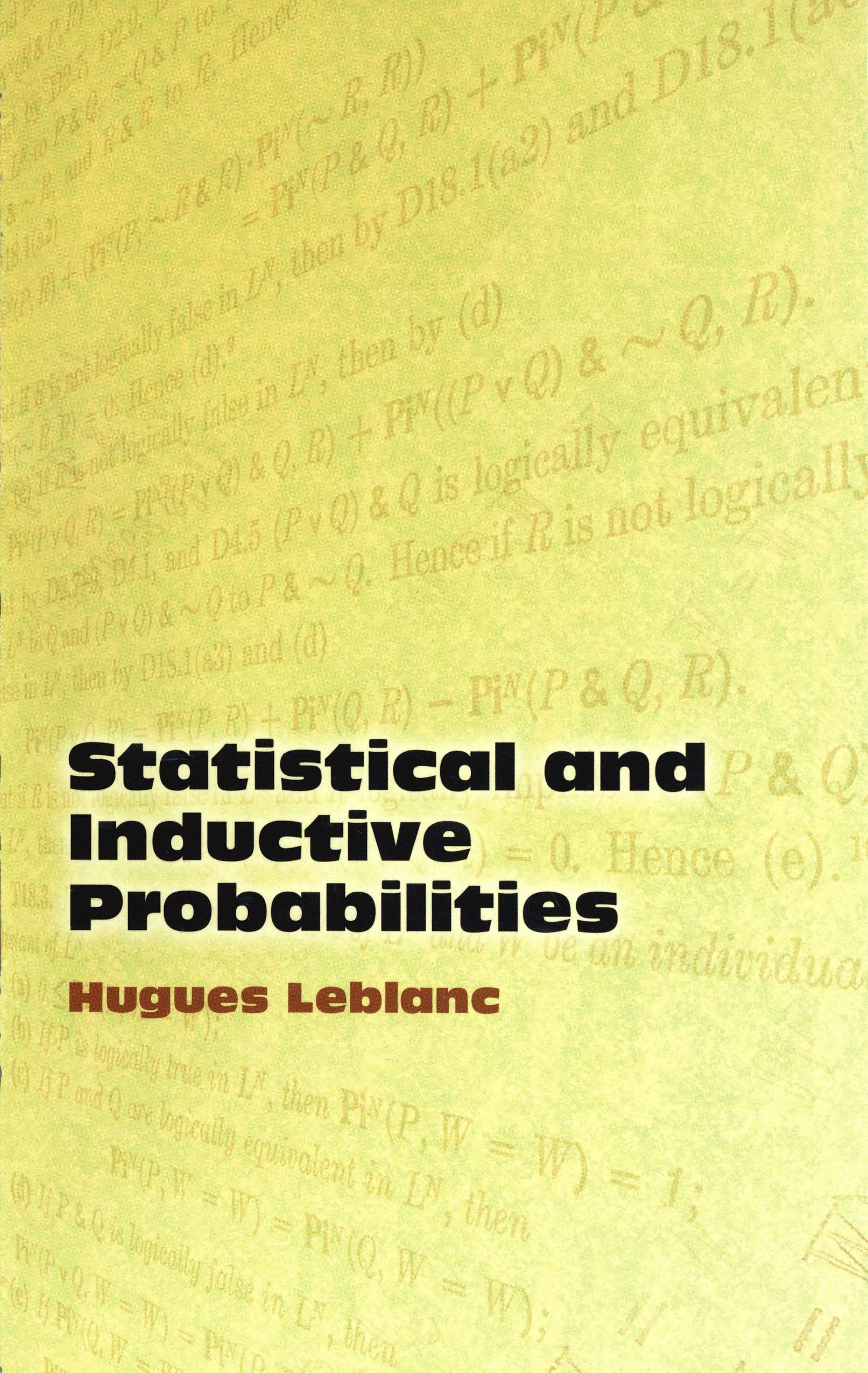
Among probability theorists, a bitter controversy has raged for decades between the adherents of John Maynard Keynes' A Treatise on Probability (1921) and those of Richard von Mises' "Grundlagen der Wahrscheinlichkeitsrechnung" (1919). Keynes declared that probabilities measure the extent to which a so-called evidence proposition supports another sentence. Von Mises insisted that they measure the relative frequency with which the members of a so-called reference set belong to another set. Statistical and Inductive Probabilities offers an evenhanded treatment of this issue, asserting that both statistical and inductive probabilities may be treated as sentence-theoretic measurements, and that the latter qualify as estimates of the former.
Beginning with a survey of the essentials of sentence theory and of set theory, author Hugues Leblanc examines statistical probabilities (which are allotted to sets by von Mises' followers), showing that statistical probabilities may be passed on to sentences, and thereby qualify as truth-values. Leblanc concludes with an exploration of inductive probabilities (which Keynes' followers allot to sentences), demonstrating their reinterpretation as estimates of truth-values.
Each chapter is preceded by a summary of its contents. Illustrations accompany most definitions and theorems, and footnotes elucidate technicalities and bibliographical references.
Beginning with a survey of the essentials of sentence theory and of set theory, author Hugues Leblanc examines statistical probabilities (which are allotted to sets by von Mises' followers), showing that statistical probabilities may be passed on to sentences, and thereby qualify as truth-values. Leblanc concludes with an exploration of inductive probabilities (which Keynes' followers allot to sentences), demonstrating their reinterpretation as estimates of truth-values.
Each chapter is preceded by a summary of its contents. Illustrations accompany most definitions and theorems, and footnotes elucidate technicalities and bibliographical references.
Payez facilement par carte, Klarna, Apple Pay ou Google Pay. Pas satisfait ? Vous avez toujours une garantie de remboursement de 14 jours. En savoir plus dans nos conditions. Si vous avez des questions, envoyez-nous un e-mail à hello@memmo.org.
Memmo facilite tes études, où que tu sois dans le monde. On rassemble tes manuels de cours et des outils d'étude intelligents au même endroit : résumés, quiz, podcasts et flashcards. Et il y a Ted, ton compagnon d'étude qui répond à toutes tes questions. Plus de 50 000 étudiants étudient déjà ici – conçu pour t'aider à apprendre plus vite et à moins stresser.
Tu pourrais aussi aimer
Acheter le livre0