
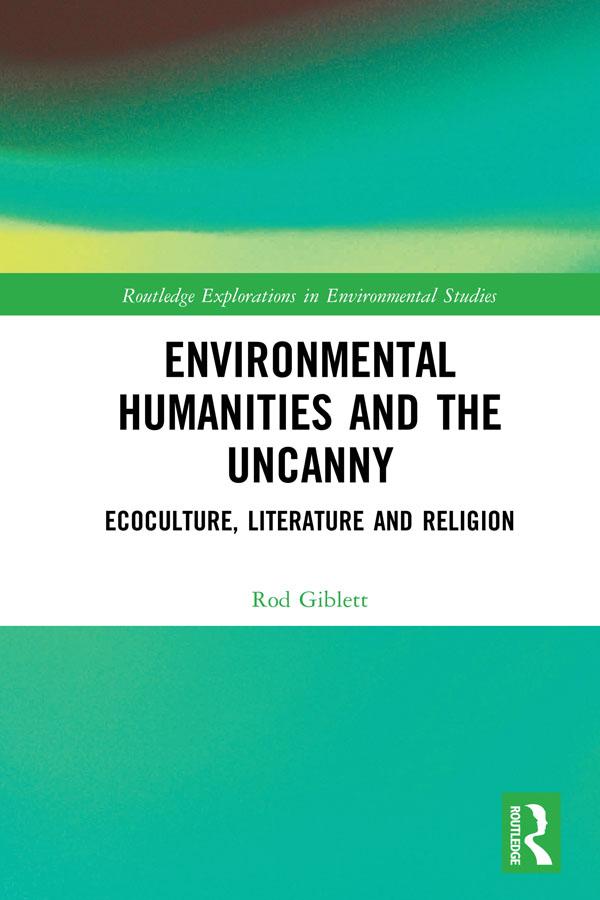
Sigmund Freud’s essay 'The Uncanny' is celebrating a century since publication. It is arguably his greatest and most fruitful contribution to the study of culture and the environment. Environmental Humanities and the Uncanny brings into the open neglected aspects of the uncanny in this famous essay in its centenary year and in the work of those before and after him, such as Friedrich Schelling, Walter Benjamin, E. T. A. Hoffmann and Bram Stoker.
This book does so by focussing on religion, especially at a time and for a world in which some sectors of the monotheisms are in aggressive, and sometimes violent, contention against those of other monotheisms, and even against other sectors within their own monotheism. The chapter on Schelling’s uncanny argues that monotheisms come out of polytheism and makes the plea for polytheism central to the whole book. It enables rethinking the relationships between mythology and monotheistic and polytheistic religions in a culturally and politically liberatory and progressive way. Succeeding chapters consider the uncanny cyborg, the uncanny and the fictional, and the uncanny and the Commonwealth, concluding with a chapter on Taoism as a polytheistic religion.
Building on the author’s previous work in Environmental Humanities and Theologies in bringing together theories of religion and the environment, this book will be of great interest to students and scholars of the environmental humanities, ecocultural studies and religion.
Payez facilement par carte, Klarna, Apple Pay ou Google Pay. Pas satisfait ? Vous avez toujours une garantie de remboursement de 14 jours. En savoir plus dans nos conditions. Si vous avez des questions, envoyez-nous un e-mail à hello@memmo.org.
Memmo facilite tes études, où que tu sois dans le monde. On rassemble tes manuels de cours et des outils d'étude intelligents au même endroit : résumés, quiz, podcasts et flashcards. Et il y a Ted, ton compagnon d'étude qui répond à toutes tes questions. Plus de 50 000 étudiants étudient déjà ici – conçu pour t'aider à apprendre plus vite et à moins stresser.