
Money and support tend to flow in the direction of economics, science, and other academic departments that demonstrate measurable "progress." The humanities, on the other hand, offer more abstract and uncertain outcomes. A humanist's objects of study are more obscure in certain ways than pathogens and cells. Consequently, it seems as if the humanities never truly progress. Is this a fair assessment?
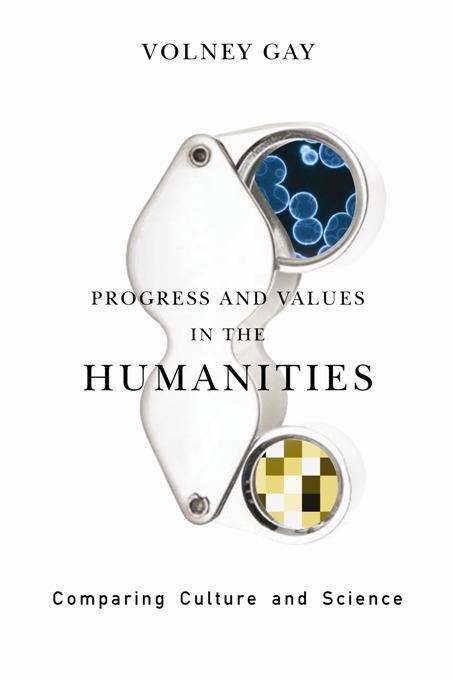
By comparing objects of science, such as the brain, the galaxy, the amoeba, and the quark, with objects of humanistic inquiry, such as the poem, the photograph, the belief, and the philosophical concept, Volney Gay reestablishes a fundamental distinction between science and the humanities. He frees the latter from its pursuit of material-based progress and restores its disciplines to a place of privilege and respect. Using the metaphor of magnification, Gay shows that, while we can investigate natural objects to the limits of imaging capacity, magnifying cultural objects dissolves them into noise. In other words, cultural objects can be studied only within their contexts and through the prism of metaphor and narrative.
Gathering examples from literature, art, film, philosophy, religion, science, and psychoanalysis, Gay builds a new justification for the humanities. By revealing the unseen and making abstract ideas tangible, the arts create meaningful wholes, which itself is a form of progress.
Payez facilement par carte, Klarna, Apple Pay ou Google Pay. Pas satisfait ? Vous avez toujours une garantie de remboursement de 14 jours. En savoir plus dans nos conditions. Si vous avez des questions, envoyez-nous un e-mail à hello@memmo.org.
Memmo facilite tes études, où que tu sois dans le monde. On rassemble tes manuels de cours et des outils d'étude intelligents au même endroit : résumés, quiz, podcasts et flashcards. Et il y a Ted, ton compagnon d'étude qui répond à toutes tes questions. Plus de 50 000 étudiants étudient déjà ici – conçu pour t'aider à apprendre plus vite et à moins stresser.