
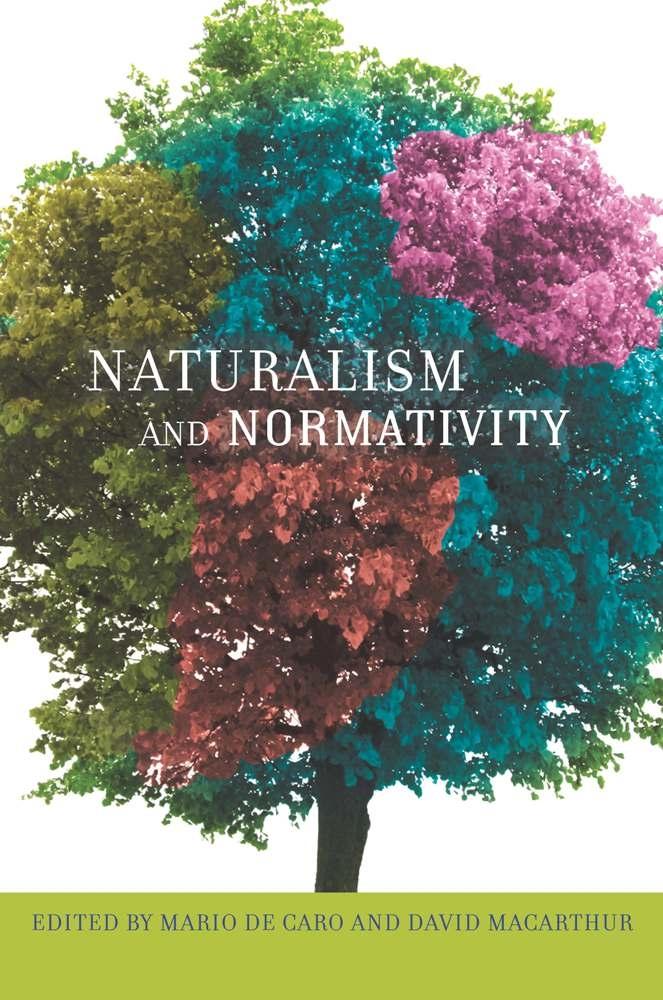
Normativity concerns what we ought to think or do and the evaluations we make. For example, we say that we ought to think consistently, we ought to keep our promises, or that Mozart is a better composer than Salieri. Yet what philosophical moral can we draw from the apparent absence of normativity in the scientific image of the world? For scientific naturalists, the moral is that the normative must be reduced to the nonnormative, while for nonnaturalists, the moral is that there must be a transcendent realm of norms.
Naturalism and Normativity engages with both sides of this debate. Essays explore philosophical options for understanding normativity in the space between scientific naturalism and Platonic supernaturalism. They articulate a liberal conception of philosophy that is neither reducible to the sciences nor completely independent of themyet one that maintains the right to call itself naturalism. Contributors think in new ways about the relations among the scientific worldview, our experience of norms and values, and our movements in the space of reason. Detailed discussions include the relationship between philosophy and science, physicalism and ontological pluralism, the realm of the ordinary, objectivity and subjectivity, truth and justification, and the liberal naturalisms of Donald Davidson, John Dewey, John McDowell, and Ludwig Wittgenstein.
Payez facilement par carte, Klarna, Apple Pay ou Google Pay. Pas satisfait ? Vous avez toujours une garantie de remboursement de 14 jours. En savoir plus dans nos conditions. Si vous avez des questions, envoyez-nous un e-mail à hello@memmo.org.
Memmo facilite tes études, où que tu sois dans le monde. On rassemble tes manuels de cours et des outils d'étude intelligents au même endroit : résumés, quiz, podcasts et flashcards. Et il y a Ted, ton compagnon d'étude qui répond à toutes tes questions. Plus de 50 000 étudiants étudient déjà ici – conçu pour t'aider à apprendre plus vite et à moins stresser.