
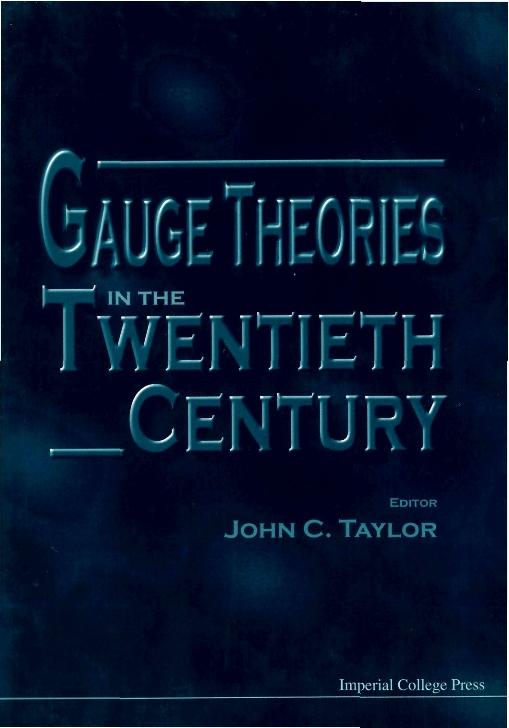
By the end of the 1970s, it was clear that all the known forces of nature (including, in a sense, gravity) were examples of gauge theories, characterized by invariance under symmetry transformations chosen independently at each position and each time. These ideas culminated with the finding of the W and Z gauge bosons (and perhaps also the Higgs boson). This important book brings together the key papers in the history of gauge theories, including the discoveries of: the role of gauge transformations in the quantum theory of electrically charged particles in the 1920s; nonabelian gauge groups in the 1950s; vacuum symmetry-breaking in the 1960s; asymptotic freedom in the 1970s. A short introduction explains the significance of the papers, and the connections between them.
Maksa helposti kortilla, Klarnalla, Apple Paylla tai Google Paylla. Etkö ole tyytyväinen? Sinulla on aina 14 päivän palautusoikeus. Lue lisää ehdoistamme. Jos sinulla on kysyttävää, lähetä meille sähköpostia osoitteeseen hello@memmo.org.
Memmo tekee opiskelusta helpompaa – missä päin maailmaa ikinä oletkin. Meillä yhdistät kurssikirjat ja fiksut opiskelutyökalut yhteen paikkaan: tiivistelmät, visat, podcastit ja muistikortit. Ja sitten Ted, opiskelukaverisi, joka vastaa kaikkeen, mitä ikinä mietitkin. Yli 50 000 opiskelijaa opiskelee jo täällä – rakennettu auttamaan sinua oppimaan nopeammin ja stressaamaan vähemmän.
Saatat pitää myös näistä
Osta kirja0