
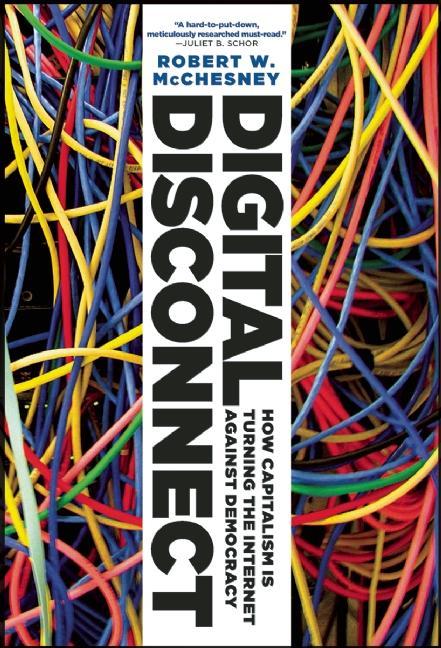
Celebrants and skeptics alike have produced valuable analyses of the Internet's effect on us and our world, oscillating between utopian bliss and dystopian hell. But according to Robert W. McChesney, arguments on both sides fail to address the relationship between economic power and the digital world.
McChesney's award-winning Rich Media, Poor Democracy skewered the assumption that a society drenched in commercial information is a democratic one. In Digital Disconnect McChesney returns to this provocative thesis in light of the advances of the digital age, incorporating capitalism into the heart of his analysis. He argues that the sharp decline in the enforcement of antitrust violations, the increase in patents on digital technology and proprietary systems, and other policies and massive indirect subsidies have made the Internet a place of numbing commercialism. A small handful of monopolies now dominate the political economy, from Google, which garners an astonishing 97 percent share of the mobile search market, to Microsoft, whose operating system is used by over 90 percent of the world's computers. This capitalistic colonization of the Internet has spurred the collapse of credible journalism, and made the Internet an unparalleled apparatus for government and corporate surveillance, and a disturbingly anti-democratic force.
In Digital Disconnect Robert McChesney offers a groundbreaking analysis and critique of the Internet, urging us to reclaim the democratizing potential of the digital revolution while we still can.
McChesney's award-winning Rich Media, Poor Democracy skewered the assumption that a society drenched in commercial information is a democratic one. In Digital Disconnect McChesney returns to this provocative thesis in light of the advances of the digital age, incorporating capitalism into the heart of his analysis. He argues that the sharp decline in the enforcement of antitrust violations, the increase in patents on digital technology and proprietary systems, and other policies and massive indirect subsidies have made the Internet a place of numbing commercialism. A small handful of monopolies now dominate the political economy, from Google, which garners an astonishing 97 percent share of the mobile search market, to Microsoft, whose operating system is used by over 90 percent of the world's computers. This capitalistic colonization of the Internet has spurred the collapse of credible journalism, and made the Internet an unparalleled apparatus for government and corporate surveillance, and a disturbingly anti-democratic force.
In Digital Disconnect Robert McChesney offers a groundbreaking analysis and critique of the Internet, urging us to reclaim the democratizing potential of the digital revolution while we still can.
Maksa helposti kortilla, Klarnalla, Apple Paylla tai Google Paylla. Etkö ole tyytyväinen? Sinulla on aina 14 päivän palautusoikeus. Lue lisää ehdoistamme. Jos sinulla on kysyttävää, lähetä meille sähköpostia osoitteeseen hello@memmo.org.
Memmo tekee opiskelusta helpompaa – missä päin maailmaa ikinä oletkin. Meillä yhdistät kurssikirjat ja fiksut opiskelutyökalut yhteen paikkaan: tiivistelmät, visat, podcastit ja muistikortit. Ja sitten Ted, opiskelukaverisi, joka vastaa kaikkeen, mitä ikinä mietitkin. Yli 50 000 opiskelijaa opiskelee jo täällä – rakennettu auttamaan sinua oppimaan nopeammin ja stressaamaan vähemmän.
Saatat pitää myös näistä
Osta kirja0