
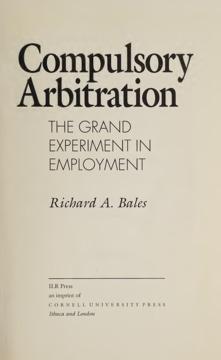
This is the first book on a crucial issue in human resource management. In recent years, employers have begun to require, as a condition of employment, that their nonunion employees agree to arbitrate rather than litigate any employment disputes, including claims of discrimination. As the number of employers considering such a requirement soars, so does the fear that compulsory arbitration may eviscerate the statutory rights of employees.
Richard A. Bales explains that the advantages of arbitration are clear. Much faster and less expensive than litigation, arbitration provides a forum for the many employees who are shut out of the current litigative system by the cost and by the tremendous backlog of cases. On the other hand, employers could use arbitration abusively. Bales views the current situation as an ongoing experiment. As long as the courts continue to enforce agreements that are fundamentally fair to employees, the experiment will continue.
After tracing the history of employment arbitration in the nonunion sector, Bales explains how employment arbitration has actually worked in the securities industry and at Brown & Root, a company with a comprehensive dispute resolution process. He concludes by summarizing the advantages, disadvantages, and policy implications of adopting arbitration as the preeminent method of resolving disputes in the American workforce.
Maksa helposti kortilla, Klarnalla, Apple Paylla tai Google Paylla. Etkö ole tyytyväinen? Sinulla on aina 14 päivän palautusoikeus. Lue lisää ehdoistamme. Jos sinulla on kysyttävää, lähetä meille sähköpostia osoitteeseen hello@memmo.org.
Memmo tekee opiskelusta helpompaa – missä päin maailmaa ikinä oletkin. Meillä yhdistät kurssikirjat ja fiksut opiskelutyökalut yhteen paikkaan: tiivistelmät, visat, podcastit ja muistikortit. Ja sitten Ted, opiskelukaverisi, joka vastaa kaikkeen, mitä ikinä mietitkin. Yli 50 000 opiskelijaa opiskelee jo täällä – rakennettu auttamaan sinua oppimaan nopeammin ja stressaamaan vähemmän.