
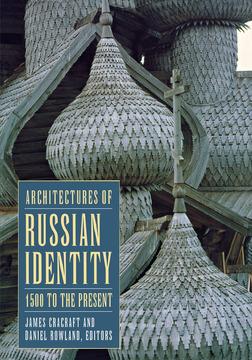
From the royal pew of Ivan the Terrible, to Catherine the Great's use of landscape, to the struggles between the Orthodox Church and preservationists in post-Soviet Yaroslavl—across five centuries of Russian history, Russian leaders have used architecture to project unity, identity, and power. Church architecture has inspired national cohesion and justified political control while representing the claims of religion in brick, wood, and stone. The architectural vocabulary of the Soviet state celebrated industrialization, mechanization, and communal life. Buildings and landscapes have expressed utopian urges as well as lofty spiritual goals. Country houses and memorials have encoded their own messages.
In Architectures of Russian Identity, James Cracraft and Daniel Rowland gather a group of authors from a wide variety of backgrounds—including history and architectural history, linguistics, literary studies, geography, and political science—to survey the political and symbolic meanings of many different kinds of structures. Fourteen heavily illustrated chapters demonstrate the remarkable fertility of the theme of architecture, broadly defined, for a range of fields dealing with Russia and its surrounding territories. The authors engage key terms in contemporary historiography—identity, nationality, visual culture—and assess the applications of each in Russian contexts.
Maksa helposti kortilla, Klarnalla, Apple Paylla tai Google Paylla. Etkö ole tyytyväinen? Sinulla on aina 14 päivän palautusoikeus. Lue lisää ehdoistamme. Jos sinulla on kysyttävää, lähetä meille sähköpostia osoitteeseen hello@memmo.org.
Memmo tekee opiskelusta helpompaa – missä päin maailmaa ikinä oletkin. Meillä yhdistät kurssikirjat ja fiksut opiskelutyökalut yhteen paikkaan: tiivistelmät, visat, podcastit ja muistikortit. Ja sitten Ted, opiskelukaverisi, joka vastaa kaikkeen, mitä ikinä mietitkin. Yli 50 000 opiskelijaa opiskelee jo täällä – rakennettu auttamaan sinua oppimaan nopeammin ja stressaamaan vähemmän.