
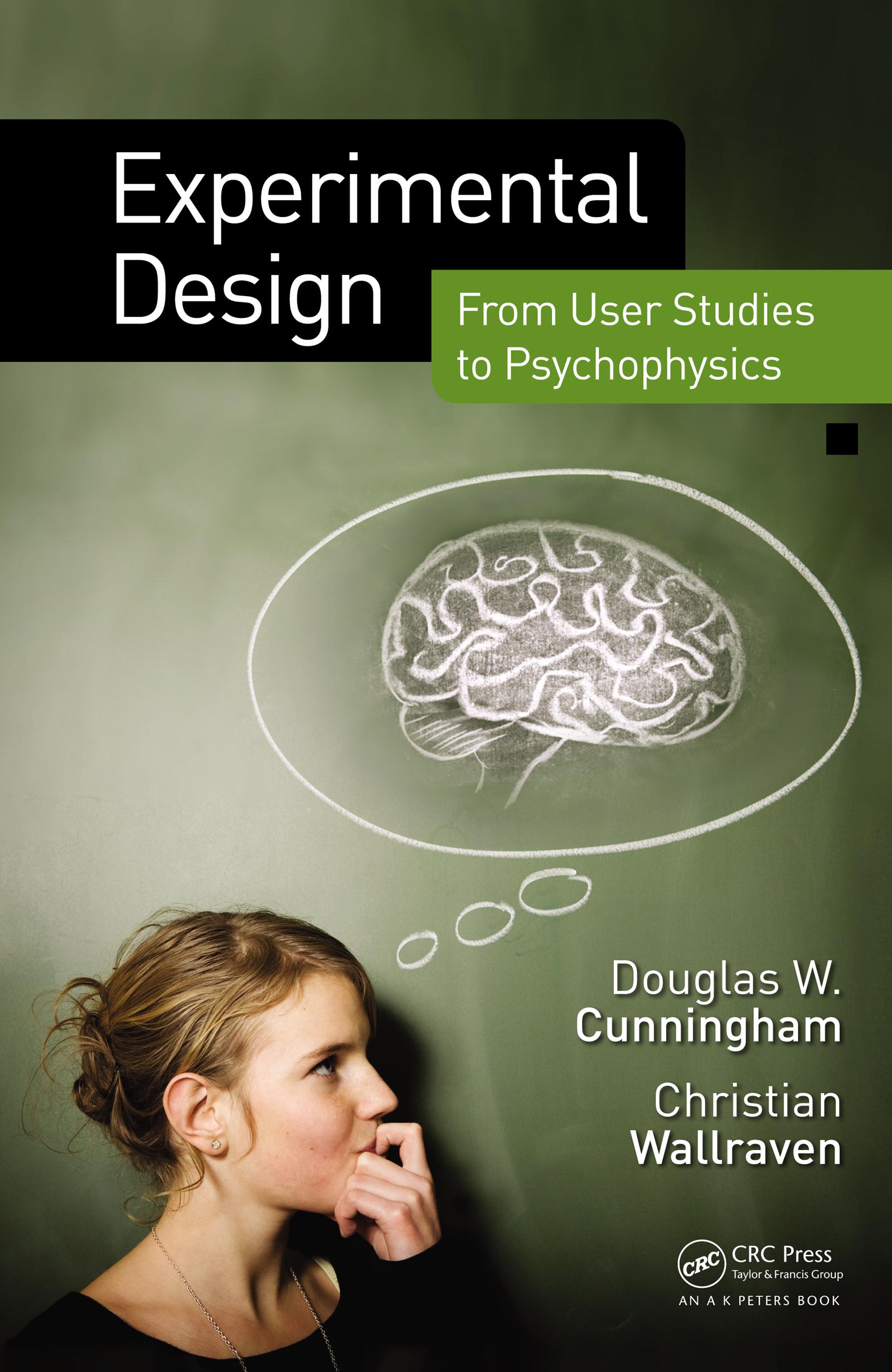
As computers proliferate and as the field of computer graphics matures, it has become increasingly important for computer scientists to understand how users perceive and interpret computer graphics. Experimental Design: From User Studies to Psychophysics is an accessible introduction to psychological experiments and experimental design, covering the major components in the design, execution, and analysis of perceptual studies.
The book begins with an introduction to the concepts central to designing and understanding experiments, including developing a research question, setting conditions and controls, and balancing specificity with generality. The book then explores in detail a number of types of experimental tasks: free description, rating scales, forced-choice, specialized multiple choice, and real-world tasks as well as physiological studies. It discusses the advantages and disadvantages of each type and provides examples of that type of experiment from the authors’ own work. The book also covers stimulus-related issues, including popular stimulus resources. It concludes with a thorough examination of statistical techniques for analyzing results, including methods specific to individual tasks.
Maksa helposti kortilla, Klarnalla, Apple Paylla tai Google Paylla. Etkö ole tyytyväinen? Sinulla on aina 14 päivän palautusoikeus. Lue lisää ehdoistamme. Jos sinulla on kysyttävää, lähetä meille sähköpostia osoitteeseen hello@memmo.org.
Memmo tekee opiskelusta helpompaa – missä päin maailmaa ikinä oletkin. Meillä yhdistät kurssikirjat ja fiksut opiskelutyökalut yhteen paikkaan: tiivistelmät, visat, podcastit ja muistikortit. Ja sitten Ted, opiskelukaverisi, joka vastaa kaikkeen, mitä ikinä mietitkin. Yli 50 000 opiskelijaa opiskelee jo täällä – rakennettu auttamaan sinua oppimaan nopeammin ja stressaamaan vähemmän.