
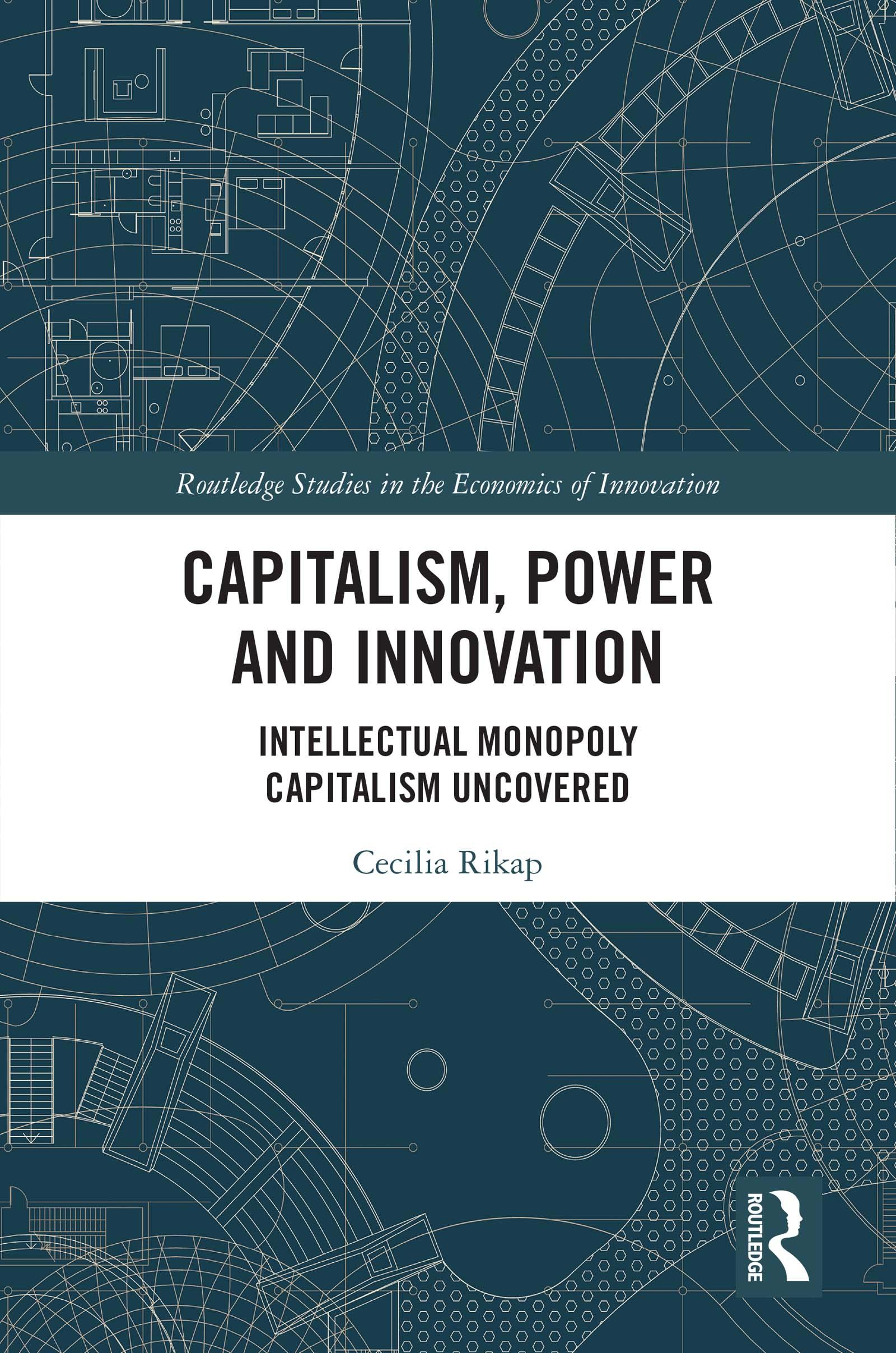
In contemporary global capitalism, the most powerful corporations are innovation or intellectual monopolies. The book’s unique perspective focuses on how private ownership and control of knowledge and data have become a major source of rent and power. The author explains how at the one pole, these corporations concentrate income, property and power in the United States, China, and in a handful of intellectual monopolies, particularly from digital and pharmaceutical industries, while at the other pole developing countries are left further behind.
The book includes detailed empirical mappings of how intellectual monopolies develop and transform knowledge from universities and open-source collaborations into intangible assets. The result is a strategy that combines undermining the commons through privatization with harvesting from the same commons. The book ends with provoking reflections to tilt the scale against intellectual monopoly capitalism and arguing that desired changes require democratic mobilization of workers and citizens at large.
This book represents one of the first attempts to capture the contours of an emerging new era where old perspectives lead us astray, and the old policy toolbox is hopelessly inadequate. This is true for the idea that the best, or only, way to promote innovation is to transform knowledge into private property. It is also true for anti-trust policies focusing exclusively on consumer prices. The formation of global infrastructures that lead to natural monopolies calls for public rather than private ownership.
Scholars and professionals from the social sciences and humanities (in particular economics, sociology, political science, geography, educational science and science and technology studies) will enjoy a clear and all-embracing depiction of innovation dynamics in contemporary capitalism, with a particular focus on asymmetries between actors, regions and topics. In fact, its topical issue broadens the book’s scope to those curious about how innovation networks shape our world.
Capitalism, Power and Innovation has won the Joan Robinson Prize, which is awarded biennially for the best monograph on a theme broadly in accord with the European Association for Evolutionary Political Economy (EAEPE) theoretical perspectives.
Maksa helposti kortilla, Klarnalla, Apple Paylla tai Google Paylla. Etkö ole tyytyväinen? Sinulla on aina 14 päivän palautusoikeus. Lue lisää ehdoistamme. Jos sinulla on kysyttävää, lähetä meille sähköpostia osoitteeseen hello@memmo.org.
Memmo tekee opiskelusta helpompaa – missä päin maailmaa ikinä oletkin. Meillä yhdistät kurssikirjat ja fiksut opiskelutyökalut yhteen paikkaan: tiivistelmät, visat, podcastit ja muistikortit. Ja sitten Ted, opiskelukaverisi, joka vastaa kaikkeen, mitä ikinä mietitkin. Yli 50 000 opiskelijaa opiskelee jo täällä – rakennettu auttamaan sinua oppimaan nopeammin ja stressaamaan vähemmän.