
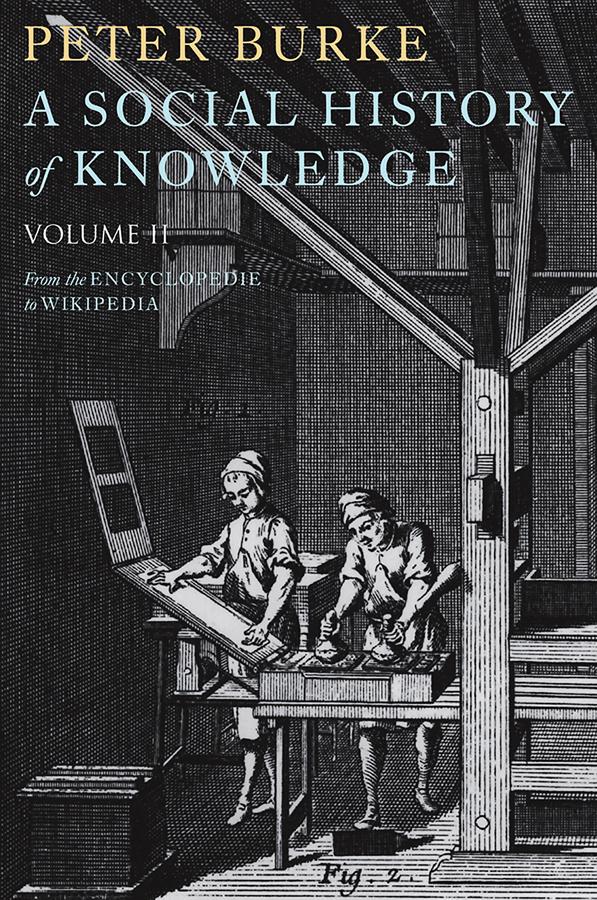
Peter Burke follows up his magisterial Social History of Knowledge, picking up where the first volume left off around 1750 at the publication of the French Encyclopédie and following the story through to Wikipedia. Like the previous volume, it offers a social history (or a retrospective sociology of knowledge) in the sense that it focuses not on individuals but on groups, institutions, collective practices and general trends.
The book is divided into 3 parts. The first argues that activities which appear to be timeless - gathering knowledge, analysing, disseminating and employing it - are in fact time-bound and take different forms in different periods and places. The second part tries to counter the tendency to write a triumphalist history of the 'growth' of knowledge by discussing losses of knowledge and the price of specialization. The third part offers geographical, sociological and chronological overviews, contrasting the experience of centres and peripheries and arguing that each of the main trends of the period - professionalization, secularization, nationalization, democratization, etc, coexisted and interacted with its opposite.
As ever, Peter Burke presents a breath-taking range of scholarship in prose of exemplary clarity and accessibility. This highly anticipated second volume will be essential reading across the humanities and social sciences.
Maksa helposti kortilla, Klarnalla, Apple Paylla tai Google Paylla. Etkö ole tyytyväinen? Sinulla on aina 14 päivän palautusoikeus. Lue lisää ehdoistamme. Jos sinulla on kysyttävää, lähetä meille sähköpostia osoitteeseen hello@memmo.org.
Memmo tekee opiskelusta helpompaa – missä päin maailmaa ikinä oletkin. Meillä yhdistät kurssikirjat ja fiksut opiskelutyökalut yhteen paikkaan: tiivistelmät, visat, podcastit ja muistikortit. Ja sitten Ted, opiskelukaverisi, joka vastaa kaikkeen, mitä ikinä mietitkin. Yli 50 000 opiskelijaa opiskelee jo täällä – rakennettu auttamaan sinua oppimaan nopeammin ja stressaamaan vähemmän.