
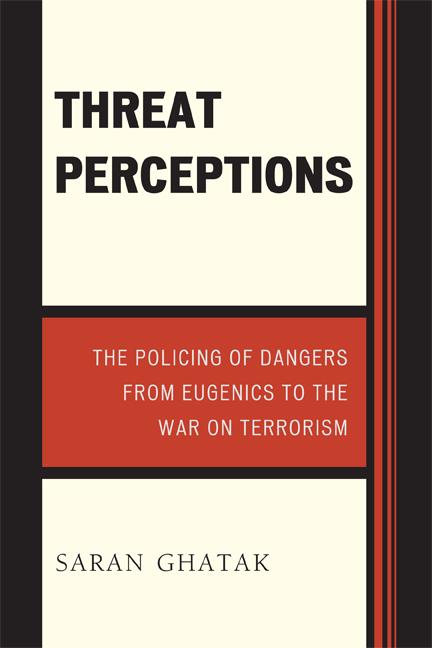
Threat Perceptions: The Policing of Dangers from Eugenics to the War on Terrorism is a study of the legal, scientific and social constructions of danger and risk of crime in the United States since the late nineteenth century. Governance of risk has emerged as an intrinsic part of the legislative and administrative processes of contemporary societies. While institutional practices of risk management are more prevalent in contemporary times, the rationality of controlling or eliminating potential risks is not necessarily new in history. Specific aspects of contemporary risk-management techniques were present in certain early twentieth-century crime control policies. Some of the earliest instances were the defective delinquency laws directed at controlling the peril of the so-called "feebleminded" criminals. Similarly, policing of political dissent before and after the advent of McCarthyism contained elements of techniques that have been revised and expanded in the contemporary era of the PATRIOT Act.
The very idea of "risk" is contingent on, and produced through the intersection of various social processes. Prevailing social conditions and political trends influence the production of risk perceptions, just as legislations and judicial precedents institutionalize the calculation and control of risk by criminal justice and security apparatuses of a nation. Simultaneously, the prediction of risk is established by scientific discourses and practices, as psychological profiles, statistical models, and other measures of risk factors render the future calculable-hence, predictable. Thus, a comprehensive understanding of risk management and security practices necessitates the analysis of these processes that essentially transforms a possibility into reality, which then forms the basis of public policies and governmental processes.
The very idea of "risk" is contingent on, and produced through the intersection of various social processes. Prevailing social conditions and political trends influence the production of risk perceptions, just as legislations and judicial precedents institutionalize the calculation and control of risk by criminal justice and security apparatuses of a nation. Simultaneously, the prediction of risk is established by scientific discourses and practices, as psychological profiles, statistical models, and other measures of risk factors render the future calculable-hence, predictable. Thus, a comprehensive understanding of risk management and security practices necessitates the analysis of these processes that essentially transforms a possibility into reality, which then forms the basis of public policies and governmental processes.
Maksa helposti kortilla, Klarnalla, Apple Paylla tai Google Paylla. Etkö ole tyytyväinen? Sinulla on aina 14 päivän palautusoikeus. Lue lisää ehdoistamme. Jos sinulla on kysyttävää, lähetä meille sähköpostia osoitteeseen hello@memmo.org.
Memmo tekee opiskelusta helpompaa – missä päin maailmaa ikinä oletkin. Meillä yhdistät kurssikirjat ja fiksut opiskelutyökalut yhteen paikkaan: tiivistelmät, visat, podcastit ja muistikortit. Ja sitten Ted, opiskelukaverisi, joka vastaa kaikkeen, mitä ikinä mietitkin. Yli 50 000 opiskelijaa opiskelee jo täällä – rakennettu auttamaan sinua oppimaan nopeammin ja stressaamaan vähemmän.