
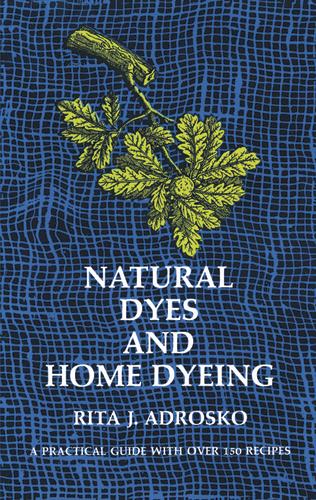
Here in a single volume is all the information you will need to extract dyestuffs from common trees, flowers, lichens, and weeds — all the information you need to create beautifully dyed materials after your own fancy, distinctive and individual.
The heart of this book is fifty-two recipes for dyes made from natural, easily obtained dyestuffs: brown dyes from the bark of apple, birch, hemlock, hickory, and maple trees; yellows from a wide variety of sources such as arsemart, white ash bark, barberry bark, sassafras, lichens, camomile flowers, and coffee beans; reds from madder, cochineal, Brazilwood, and alkanet; blues from woad, chemic, orchil and cudbear, as well as from the popular indigo; and blacks most commonly made from logwood and soot. There is also the possibility of combining any of these by top-dyeing (successive dyeing) — instructions for which are given.
Each recipe gives you step-by-step instructions that tell you how to prepare your ingredients, how to shred, soak, dissolve, and boil the materials you collect, how to prepare your cloth (whether cotton or wood) for dyeing, and exactly how long to boil it for optimum results.
Besides the fifty-two recipes, most of which are given in several versions, Miss Adrosko deepens your knowledge of dyeing techniques with a history of the craft before the discovery of America, among the colonists, and after 1850 when synthetic dyes began to be used. Appendixes list dyes mentioned in early dyers' manuals printed in America, and give excerpts from three 19th-century treatises which reveal literally hundreds of sources for natural dyestuffs. Concisely written, well organized, this book will not only let you make all the dyes described in its pages, but will also give you the skills to make your own exciting discoveries in a field that has long been neglected.
The heart of this book is fifty-two recipes for dyes made from natural, easily obtained dyestuffs: brown dyes from the bark of apple, birch, hemlock, hickory, and maple trees; yellows from a wide variety of sources such as arsemart, white ash bark, barberry bark, sassafras, lichens, camomile flowers, and coffee beans; reds from madder, cochineal, Brazilwood, and alkanet; blues from woad, chemic, orchil and cudbear, as well as from the popular indigo; and blacks most commonly made from logwood and soot. There is also the possibility of combining any of these by top-dyeing (successive dyeing) — instructions for which are given.
Each recipe gives you step-by-step instructions that tell you how to prepare your ingredients, how to shred, soak, dissolve, and boil the materials you collect, how to prepare your cloth (whether cotton or wood) for dyeing, and exactly how long to boil it for optimum results.
Besides the fifty-two recipes, most of which are given in several versions, Miss Adrosko deepens your knowledge of dyeing techniques with a history of the craft before the discovery of America, among the colonists, and after 1850 when synthetic dyes began to be used. Appendixes list dyes mentioned in early dyers' manuals printed in America, and give excerpts from three 19th-century treatises which reveal literally hundreds of sources for natural dyestuffs. Concisely written, well organized, this book will not only let you make all the dyes described in its pages, but will also give you the skills to make your own exciting discoveries in a field that has long been neglected.
Maksa helposti kortilla, Klarnalla, Apple Paylla tai Google Paylla. Etkö ole tyytyväinen? Sinulla on aina 14 päivän palautusoikeus. Lue lisää ehdoistamme. Jos sinulla on kysyttävää, lähetä meille sähköpostia osoitteeseen hello@memmo.org.
Memmo tekee opiskelusta helpompaa – missä päin maailmaa ikinä oletkin. Meillä yhdistät kurssikirjat ja fiksut opiskelutyökalut yhteen paikkaan: tiivistelmät, visat, podcastit ja muistikortit. Ja sitten Ted, opiskelukaverisi, joka vastaa kaikkeen, mitä ikinä mietitkin. Yli 50 000 opiskelijaa opiskelee jo täällä – rakennettu auttamaan sinua oppimaan nopeammin ja stressaamaan vähemmän.
Saatat pitää myös näistä
Osta kirja0