
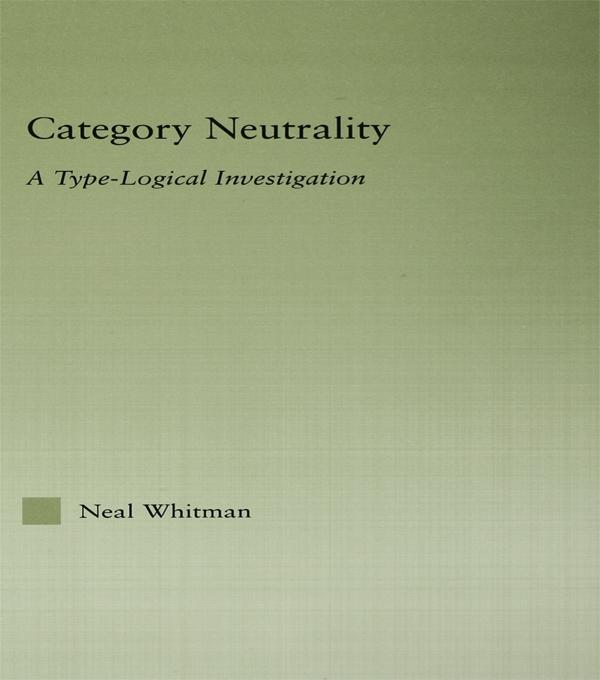
"Feature neutrality" is an issue that has received much attention among linguists. For example, consider the sentence, "I have never, and will never, put my name on this document." Here, the verb 'put' acts simultaneously as a past participle (as in "have never put") and a base form (as in "will never put"), and is therefore said to be neutral between the two forms. Similar examples have been found for many languages.
The accepted wisdom is that neutrality is possible only for morphosyntactic features such as verb form, gender, number, declension class-not at the level of gross syntactic category, where the semantic differences are more significant. In other words, it has been claimed that "category neutrality," where a word or phrase is used simultaneously with more than one syntactic category, does not exist. (A famous example is the glaring ungrammaticality of this sentence, in which "can" is used simultaneously as a main verb and auxiliary verb: "I can tuna and get a new job.") In this book, however, Neal Whitman shows that category neutrality does exist in English. This not only challenges the current thinking, but also raises foundational questions about the nature of ambiguity.
Paga fácilmente con tarjeta, Klarna, Apple Pay o Google Pay. ¿No estás contento? Siempre tienes 14 días de garantía de devolución. Lee más en nuestros términos. Si tienes preguntas, escríbenos a hello@memmo.org.
Memmo hace que estudiar sea más fácil, estés donde estés. Aquí tienes tus libros de texto y herramientas de estudio inteligentes en un solo lugar: resúmenes, quizzes, podcasts y flashcards. Y también a Ted, tu compañero de estudio que responde a todo lo que te preguntes. Más de 50 000 estudiantes ya estudian aquí. Está hecho para que aprendas más rápido y te estreses menos.