
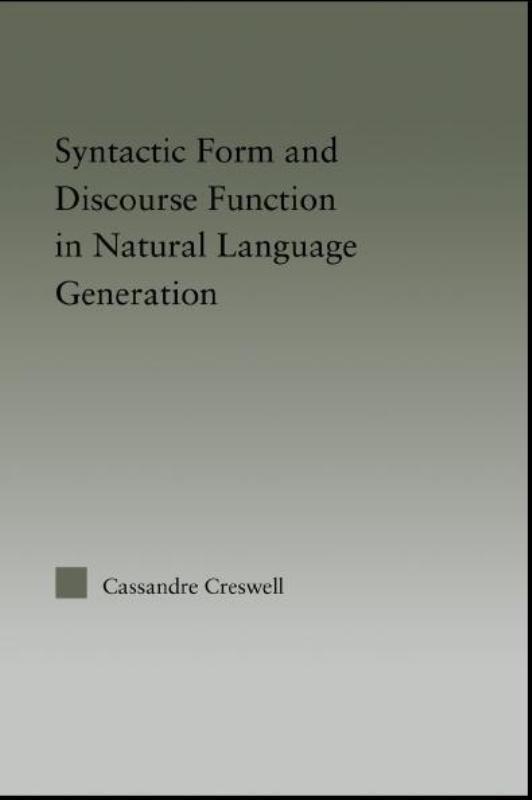
Users of natural languages have many word orders with which to encode the same truth-conditional meaning. They choose contextually appropriate strings from these many ways with little conscious effort and with effective communicative results. Previous computational models of when English speakers produce non-canonical word orders, like topicalization, left-dislocation and clefts, fail. The primary goal of this book is to present a better model of when speakers choose to produce certain non-canonical word orders by incorporating the effects of discourse context and speaker goals on syntactic choice. This book makes extensive use of previously unexamined naturally occurring corpus data of non-canonical word order in English, both to illustrate the points of the theoretical model and to train the statistical model.
Paga fácilmente con tarjeta, Klarna, Apple Pay o Google Pay. ¿No estás contento? Siempre tienes 14 días de garantía de devolución. Lee más en nuestros términos. Si tienes preguntas, escríbenos a hello@memmo.org.
Memmo hace que estudiar sea más fácil, estés donde estés. Aquí tienes tus libros de texto y herramientas de estudio inteligentes en un solo lugar: resúmenes, quizzes, podcasts y flashcards. Y también a Ted, tu compañero de estudio que responde a todo lo que te preguntes. Más de 50 000 estudiantes ya estudian aquí. Está hecho para que aprendas más rápido y te estreses menos.
También te podría gustar
Comprar el libro0