
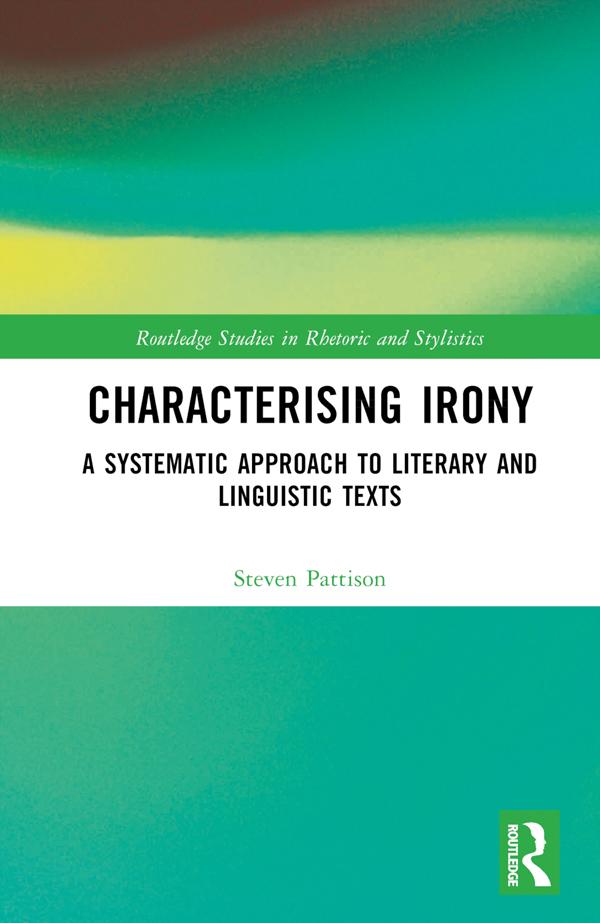
This book offers a systematic, bottom-up account of irony across both everyday contexts and literary and linguistic texts, using an empirically rigorous approach in distinguishing between central irony, non-central ironies, and non-ironies and highlighting a new way forward for irony research.
The volume considers the current landscape of irony, in which the term is used with increasing frequency with the knock-on effect of a loosening of its meaning. Pattison addresses this challenge by applying a systematic form of analysis, rooted in frameworks from pragmatics and complementary disciplines, to a database of over 500 irony candidates from a wide range of sources. The book uses these examples to illustrate the features of central ironies as well as the attributes used to differentiate between central ironies, non-central ironies, and non-ironies. These attributes are mapped across four key domains, including: difference and opposition; the role of context; how ironies are signaled; and speaker attitude and intention. Taken together, the volume puts forth a credible account for more clearly characterizing examples of irony and equips researchers with a comprehensive step-by-step method for undertaking future research.
This book is key reading for scholars in stylistics, pragmatics, literary studies, and psycholinguistics.
Paga fácilmente con tarjeta, Klarna, Apple Pay o Google Pay. ¿No estás contento? Siempre tienes 14 días de garantía de devolución. Lee más en nuestros términos. Si tienes preguntas, escríbenos a hello@memmo.org.
Memmo hace que estudiar sea más fácil, estés donde estés. Aquí tienes tus libros de texto y herramientas de estudio inteligentes en un solo lugar: resúmenes, quizzes, podcasts y flashcards. Y también a Ted, tu compañero de estudio que responde a todo lo que te preguntes. Más de 50 000 estudiantes ya estudian aquí. Está hecho para que aprendas más rápido y te estreses menos.