
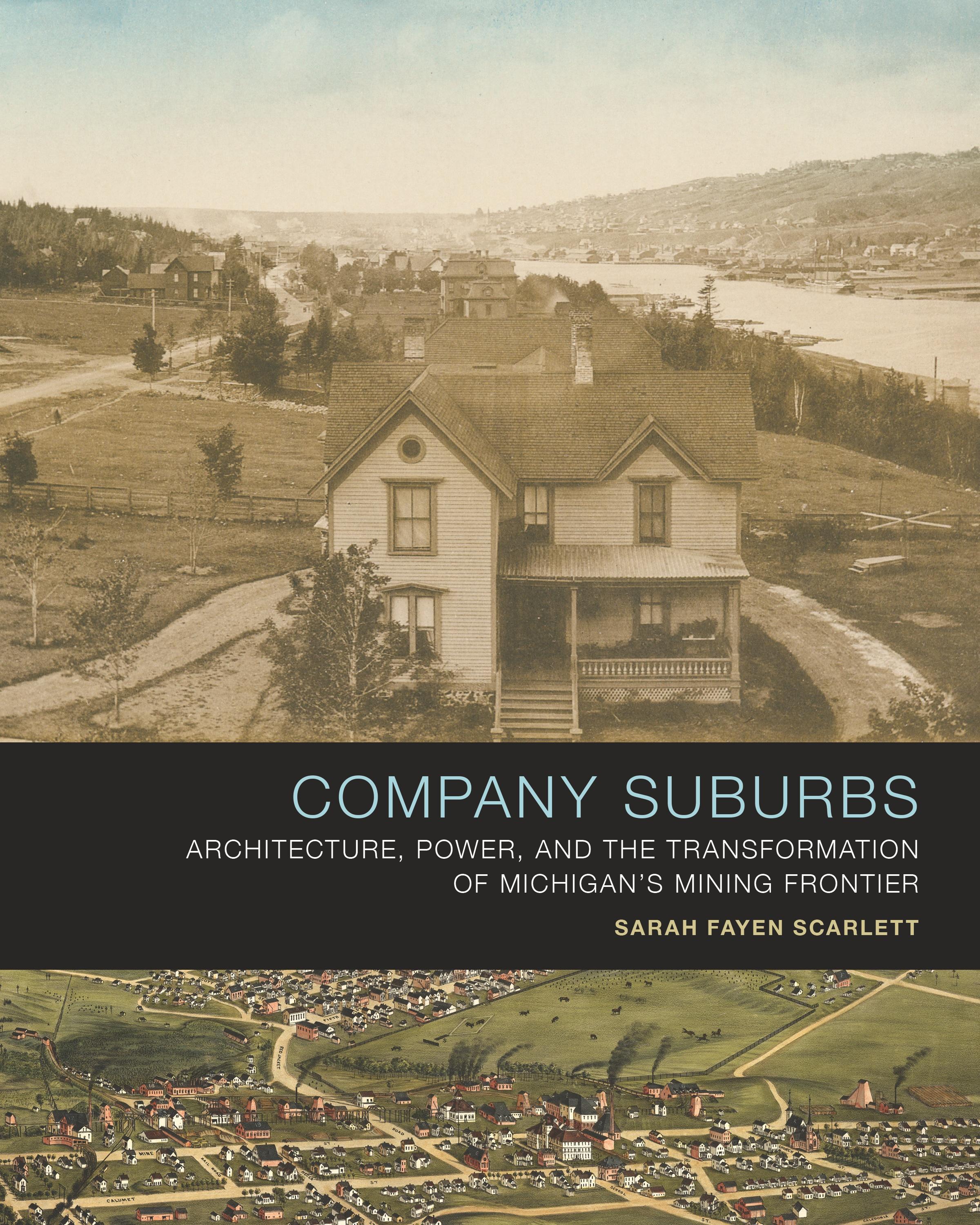
Winner of the 2022 Fred B. Kniffen Book Award from the International Society Landscape, Place, and Material Culture and the 2023 Abbott Lowell Cummings Award from the Vernacular Architecture Forum!
Michigan’s Keweenaw Peninsula juts into Lake Superior, pointing from the western Upper Peninsula toward Canada. Native peoples mined copper there for at least five thousand years, but the industrial heyday of the “Copper Country” began in the late nineteenth century, as immigrants from Cornwall, Italy, Finland, and elsewhere came to work in mines largely run from faraway cities such as New York and Boston. In those cities, suburbs had developed to allow wealthier classes to escape the dirt and grime of the industrial center. In the Copper Country, however, the suburbs sprang up nearly adjacent to mines, mills, and coal docks.
Sarah Fayen Scarlett contrasts two types of neighborhoods that transformed Michigan’s mining frontier between 1875 and 1920: paternalistic company towns built for the workers and elite suburbs created by the region’s network of business leaders. Richly illustrated with drawings, maps, and photographs, Company Suburbs details the development of these understudied cultural landscapes that arose when elites began to build housing that was architecturally distinct from that of the multiethnic workers within the old company towns. They followed national trends and created social hierarchies in the process, but also, uniquely, incorporated pre-existing mining features and adapted company housing practices. This idiosyncratic form of suburbanization belies the assumption that suburbs and industry were independent developments.
Built environments evince interrelationships among landscapes, people, and power. Scarlett’s work offers new perspectives on emerging national attitudes linking domestic architecture with class and gender identity. Company Suburbs complements scholarship on both industrial communities and early suburban growth, increasing our understanding of the ways hierarchies associated with industrial capitalism have been built into the shared environments of urban areas as well as seemingly peripheral American towns.
Pay easily by card, Klarna, Apple Pay or Google Pay. Not happy? You always have a 14-day money-back guarantee. Read more in our terms. If you have any questions, email us at hello@memmo.org.
Memmo makes studying easier – wherever you are in the world. We bring your course books and smart study tools together in one place: summaries, quizzes, podcasts and flashcards. Plus Ted, your study buddy who answers anything you wonder. Over 75,000 students already study here – built to help you learn faster and stress less.