
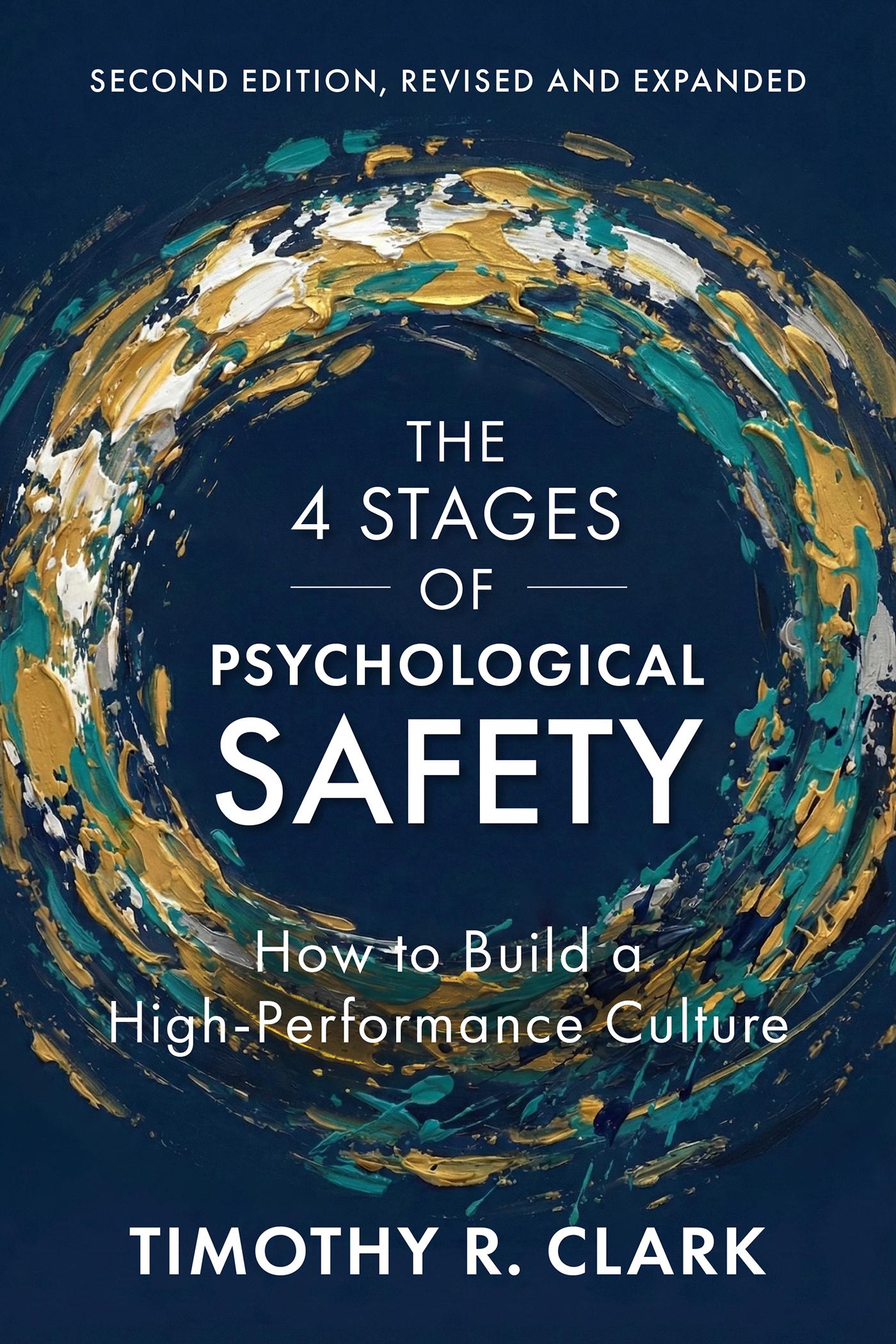
Build organizations where employees feel truly safe to learn, contribute, and challenge the status quo.
The proven practical guide to psychological safety is now expanded with updated research and powerful new frameworks and tools.
Psychological safety—the belief that you can speak up without risk of punishment or humiliation—is crucial for high-performing teams and innovative organizations. This revised and expanded edition of Timothy Clark's groundbreaking framework provides leaders with a research-backed roadmap through four distinct stages that enable individuals to feel safe, valued, and empowered.
The four stages build progressively:
This new edition adds compelling quantitative evidence from Clark's global database of 1.2 million data points, validating the four-stage model across cultures and demographics. New chapters explore what psychological safety is not, the dangers of “nice” cultures, the relationship between psychological and physical safety, and practical measurement strategies.
Leaders will learn to banish fear, create performance-based accountability, and build environments where people thrive beyond expectations.
The proven practical guide to psychological safety is now expanded with updated research and powerful new frameworks and tools.
Psychological safety—the belief that you can speak up without risk of punishment or humiliation—is crucial for high-performing teams and innovative organizations. This revised and expanded edition of Timothy Clark's groundbreaking framework provides leaders with a research-backed roadmap through four distinct stages that enable individuals to feel safe, valued, and empowered.
The four stages build progressively:
- Inclusion Safety (feeling included and accepted),
- Learner Safety (feeling safe to learn and ask questions),
- Contributor Safety (feeling safe to contribute and participate), and
- Challenger Safety (feeling safe to challenge the status quo and speak truth to power).
This new edition adds compelling quantitative evidence from Clark's global database of 1.2 million data points, validating the four-stage model across cultures and demographics. New chapters explore what psychological safety is not, the dangers of “nice” cultures, the relationship between psychological and physical safety, and practical measurement strategies.
Leaders will learn to banish fear, create performance-based accountability, and build environments where people thrive beyond expectations.
Pay easily by card, Klarna, Apple Pay or Google Pay. Not happy? You always have a 14-day money-back guarantee. Read more in our terms. If you have any questions, email us at hello@memmo.org.
Memmo makes studying easier – wherever you are in the world. We bring your course books and smart study tools together in one place: summaries, quizzes, podcasts and flashcards. Plus Ted, your study buddy who answers anything you wonder. Over 75,000 students already study here – built to help you learn faster and stress less.
You might also like
Buy the book0