
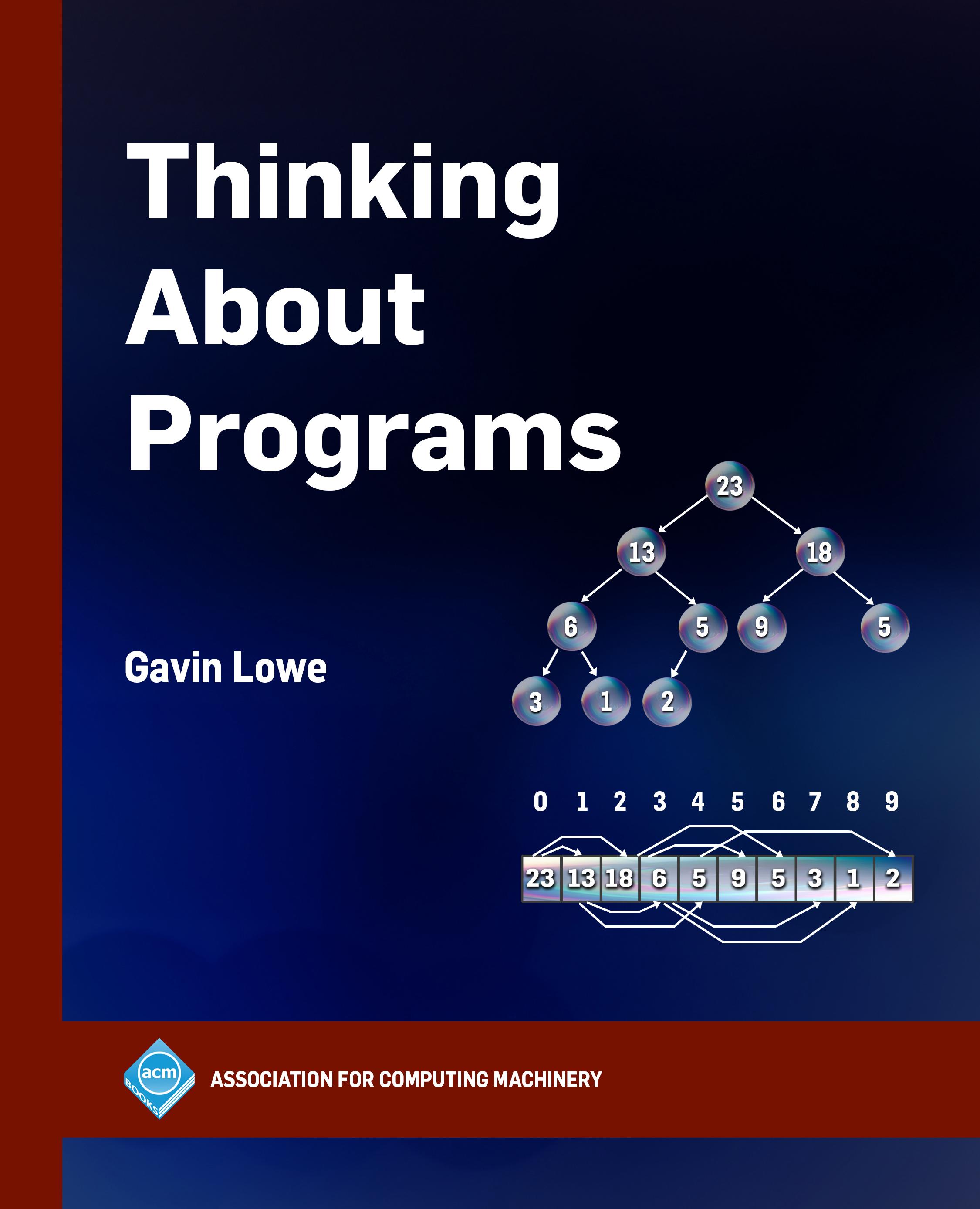
This book describes how to think about computer programs, and how to use mathematics as part of that thinking. Many books and on-line tutorials teach the basics of coding: the syntax of the language, and how to translate an algorithm into code. But how do you come up with that algorithm? And how can you be confident that the algorithm is correct?
The first part of the book considers small programs that use a loop, and how to demonstrate their correctness using loop invariants. It also covers some algorithms and algorithmic techniques that every programmer should know. The second half of the book considers slightly larger programs. It teaches the basics of modularisation, splitting up a program into manageable chunks. It teaches about abstract datatypes, values within a program that can be treated as mathematical values: how to specify their behaviours formally; and how to treat them as abstract mathematical objects when programming. It also teaches how to use data structures to represent abstract datatypes, and what it means for such a representation to be correct. And it presents some abstract datatypes and data structures that every programmer should know.
The book is aimed at those who want to obtain a better understanding of programs they work on, and so become better programmers. The target audience ranges from those who are just starting out, to professional programmers. The book aims to be pragmatic: the philosophy is to include enough formality to be convincing and to guide the programmer towards correct code, without getting bogged down in the mathematics.
Pay easily by card, Klarna, Apple Pay or Google Pay. Not happy? You always have a 14-day money-back guarantee. Read more in our terms. If you have any questions, email us at hello@memmo.org.
Memmo makes studying easier – wherever you are in the world. We bring your course books and smart study tools together in one place: summaries, quizzes, podcasts and flashcards. Plus Ted, your study buddy who answers anything you wonder. Over 75,000 students already study here – built to help you learn faster and stress less.