
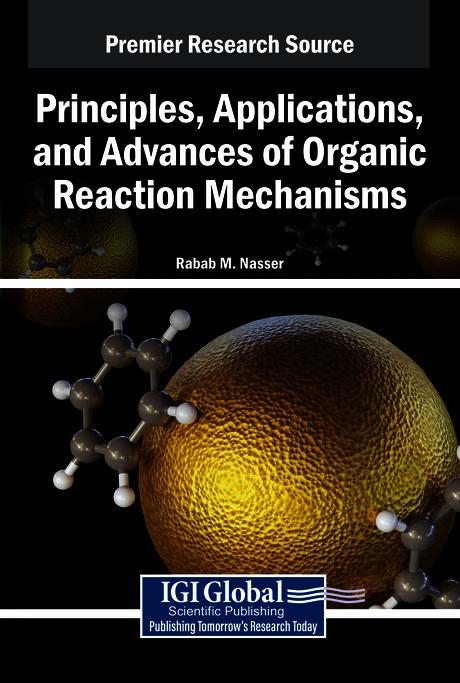
Organic reaction mechanisms are a critical part of synthetic chemistry, providing the principles explaining how and why chemical reactions occur at the molecular level. These mechanisms help chemists predict the behavior of molecules and design new synthetic routes for complex compounds. Their applications influence fields such as pharmaceutical development, materials science, and agriculture. Significant advances emerge, including the use of computational chemistry to model transition states, the development of green and sustainable reaction pathways, and improved efficiency and selectivity. Understanding these mechanisms may increase the understanding of molecular reactivity while driving innovation across chemical sciences. Principles, Applications, and Advances of Organic Reaction Mechanisms explores applications of chemical compounds and organic mechanisms. It provides a comprehensive understanding of how organic reactions occur, emphasizing fundamental reaction mechanisms like substitution, elimination, and addition. This book covers topics such as medicinal chemistry, organic compounds, and drug design, and is a useful resource for chemists, engineers, academicians, researchers, and scientists.
Pay easily by card, Klarna, Apple Pay or Google Pay. Not happy? You always have a 14-day money-back guarantee. Read more in our terms. If you have any questions, email us at hello@memmo.org.
Memmo makes studying easier – wherever you are in the world. We bring your course books and smart study tools together in one place: summaries, quizzes, podcasts and flashcards. Plus Ted, your study buddy who answers anything you wonder. Over 75,000 students already study here – built to help you learn faster and stress less.
You might also like
Buy the book0