
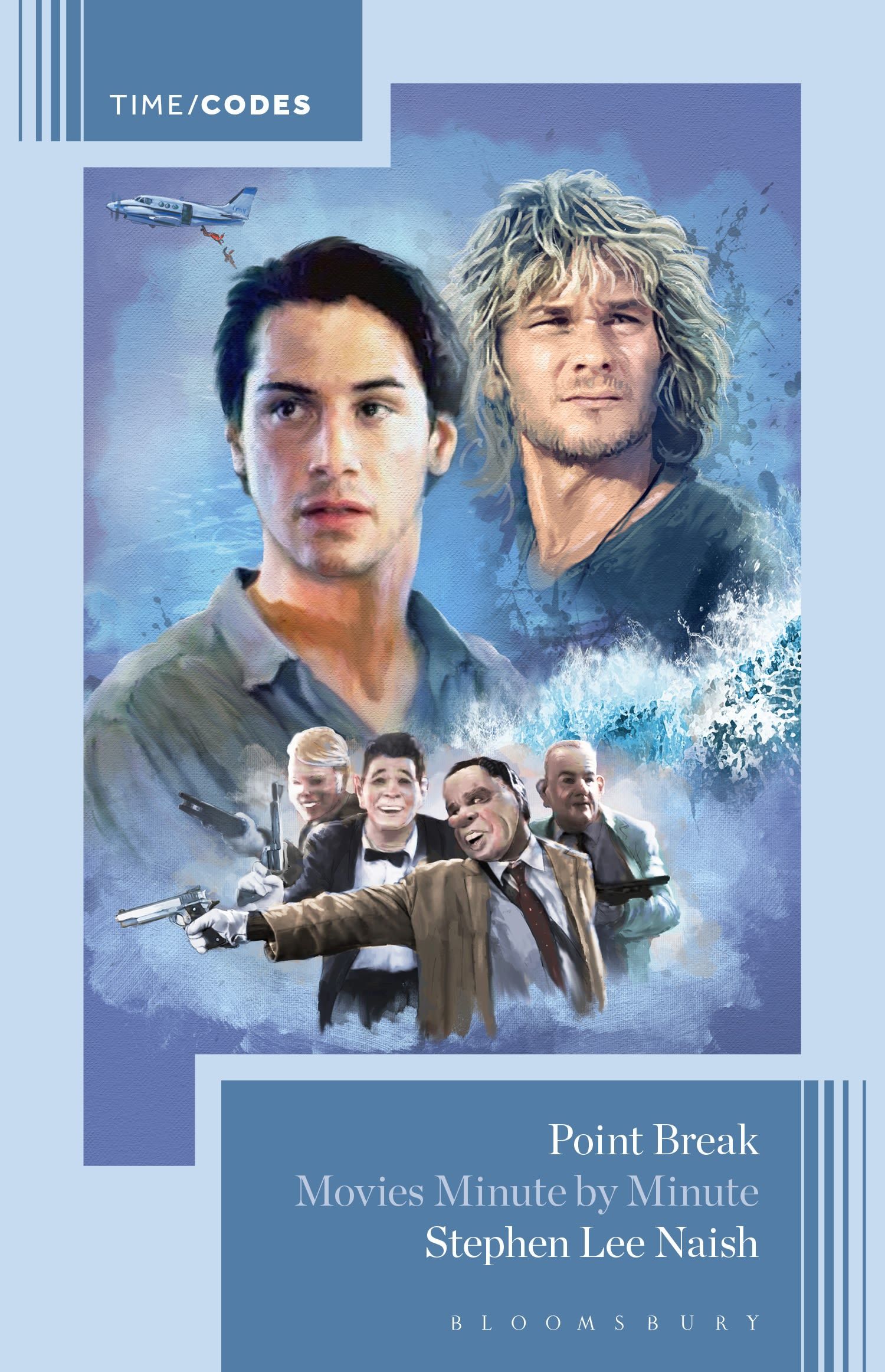
Point Break, in Bloomsbury's Timecodes Series, is a detailed, minute-by-minute critical exploration of Kathryn Bigelow's 1991 action film Point Break.
Moving sequentially through the film's two-hour runtime, the book blends formal analysis, cultural history and theory, action genre study, and personal reflection and interpretation. It positions Point Break as both a quintessential action spectacle and a film layered with thematic tensions: masculinity, spirituality, individual risk, personal freedom, environmental awareness, and the search for one's identity. Each minute of the film is treated as a self-contained unit. The cinematography, editing, sound design, performances, and narrative beats are discussed in relation to broader social contexts including surfing subculture, mid-to-late-20th-century American politics, post-Vietnam War attitudes, and the evolving media images of Keanu Reeves and Patrick Swayze.
Drawing on a wide array of sources, such as film theory, cultural criticism, and surf memoirs, the book
reframes Point Break as not merely an adrenaline-driven thriller, but as a work rich in symbolism, mythology, homoerotic desires, and philosophical inquiry. This approach reveals how Bigelow crafts a kinetic, expressive cinema where bodies, landscapes, and motion collide, and how the film's characters operate within intersecting personal, cultural, and ideological currents. The result is a hybrid of scholarship and creative writing that reanimates the film by slowing it down, revealing layers of meaning often obscured by its velocity.
Moving sequentially through the film's two-hour runtime, the book blends formal analysis, cultural history and theory, action genre study, and personal reflection and interpretation. It positions Point Break as both a quintessential action spectacle and a film layered with thematic tensions: masculinity, spirituality, individual risk, personal freedom, environmental awareness, and the search for one's identity. Each minute of the film is treated as a self-contained unit. The cinematography, editing, sound design, performances, and narrative beats are discussed in relation to broader social contexts including surfing subculture, mid-to-late-20th-century American politics, post-Vietnam War attitudes, and the evolving media images of Keanu Reeves and Patrick Swayze.
Drawing on a wide array of sources, such as film theory, cultural criticism, and surf memoirs, the book
reframes Point Break as not merely an adrenaline-driven thriller, but as a work rich in symbolism, mythology, homoerotic desires, and philosophical inquiry. This approach reveals how Bigelow crafts a kinetic, expressive cinema where bodies, landscapes, and motion collide, and how the film's characters operate within intersecting personal, cultural, and ideological currents. The result is a hybrid of scholarship and creative writing that reanimates the film by slowing it down, revealing layers of meaning often obscured by its velocity.
Pay easily by card, Klarna, Apple Pay or Google Pay. Not happy? You always have a 14-day money-back guarantee. Read more in our terms. If you have any questions, email us at hello@memmo.org.
Memmo makes studying easier – wherever you are in the world. We bring your course books and smart study tools together in one place: summaries, quizzes, podcasts and flashcards. Plus Ted, your study buddy who answers anything you wonder. Over 50,000 students already study here – built to help you learn faster and stress less.