
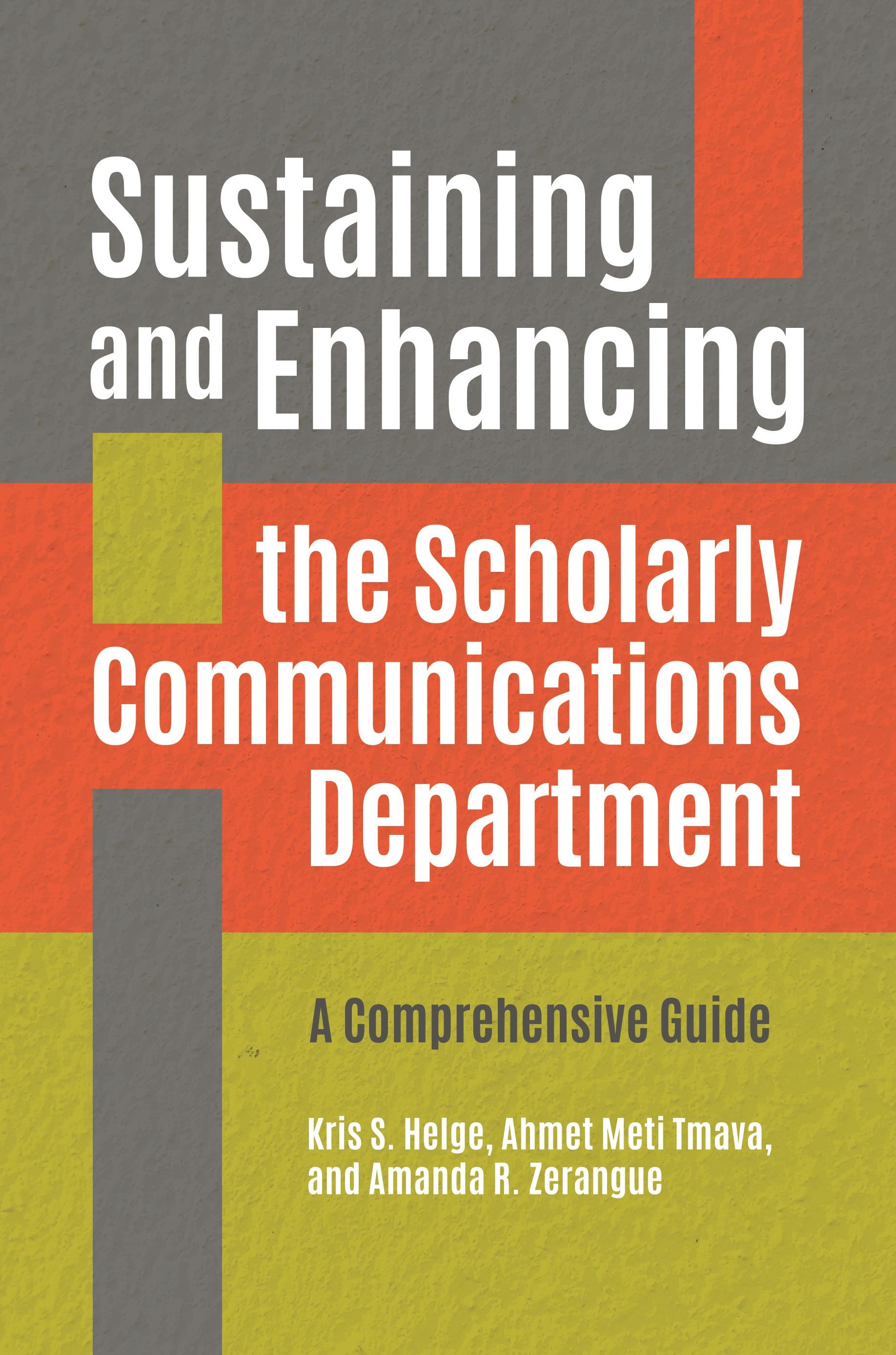
Learn how to develop, manage, and maintain a scholarly communications department.
More and more academic libraries are being asked to provide scholarly communications services to their campuses, ranging from general information about copyright law to instruction for creating and hosting digital repositories and publishing services. To support academic librarians and information specialists in starting their own scholarly communications departments, Sustaining and Enhancing the Scholarly Communications Department begins by introducing key scholarly communications concepts, including copyright, Creative Commons licenses, author rights, open access, open educational resources, open-access e-journals, and institutional repositories.
Authors Helge, Tmava, and Zerangue explain how to develop, manage, market, and maintain a scholarly communications department. They define specific tasks and tools for which many scholarly communications departments are responsible, including intellectual property, licensing issues, promoting open access, data management, and plagiarism conundrums. They also discuss strategies for collaborating with key campus stakeholders and convey which academic degrees benefit and may be necessary for personnel in a scholarly communications department. Finally, the authors offer managerial and leadership techniques to increase employee productivity, efficiency, retention, motivation, and happiness within the scholarly communications department.
More and more academic libraries are being asked to provide scholarly communications services to their campuses, ranging from general information about copyright law to instruction for creating and hosting digital repositories and publishing services. To support academic librarians and information specialists in starting their own scholarly communications departments, Sustaining and Enhancing the Scholarly Communications Department begins by introducing key scholarly communications concepts, including copyright, Creative Commons licenses, author rights, open access, open educational resources, open-access e-journals, and institutional repositories.
Authors Helge, Tmava, and Zerangue explain how to develop, manage, market, and maintain a scholarly communications department. They define specific tasks and tools for which many scholarly communications departments are responsible, including intellectual property, licensing issues, promoting open access, data management, and plagiarism conundrums. They also discuss strategies for collaborating with key campus stakeholders and convey which academic degrees benefit and may be necessary for personnel in a scholarly communications department. Finally, the authors offer managerial and leadership techniques to increase employee productivity, efficiency, retention, motivation, and happiness within the scholarly communications department.
Pay easily by card, Klarna, Apple Pay or Google Pay. Not happy? You always have a 14-day money-back guarantee. Read more in our terms. If you have any questions, email us at hello@memmo.org.
Memmo makes studying easier – wherever you are in the world. We bring your course books and smart study tools together in one place: summaries, quizzes, podcasts and flashcards. Plus Ted, your study buddy who answers anything you wonder. Over 75,000 students already study here – built to help you learn faster and stress less.