
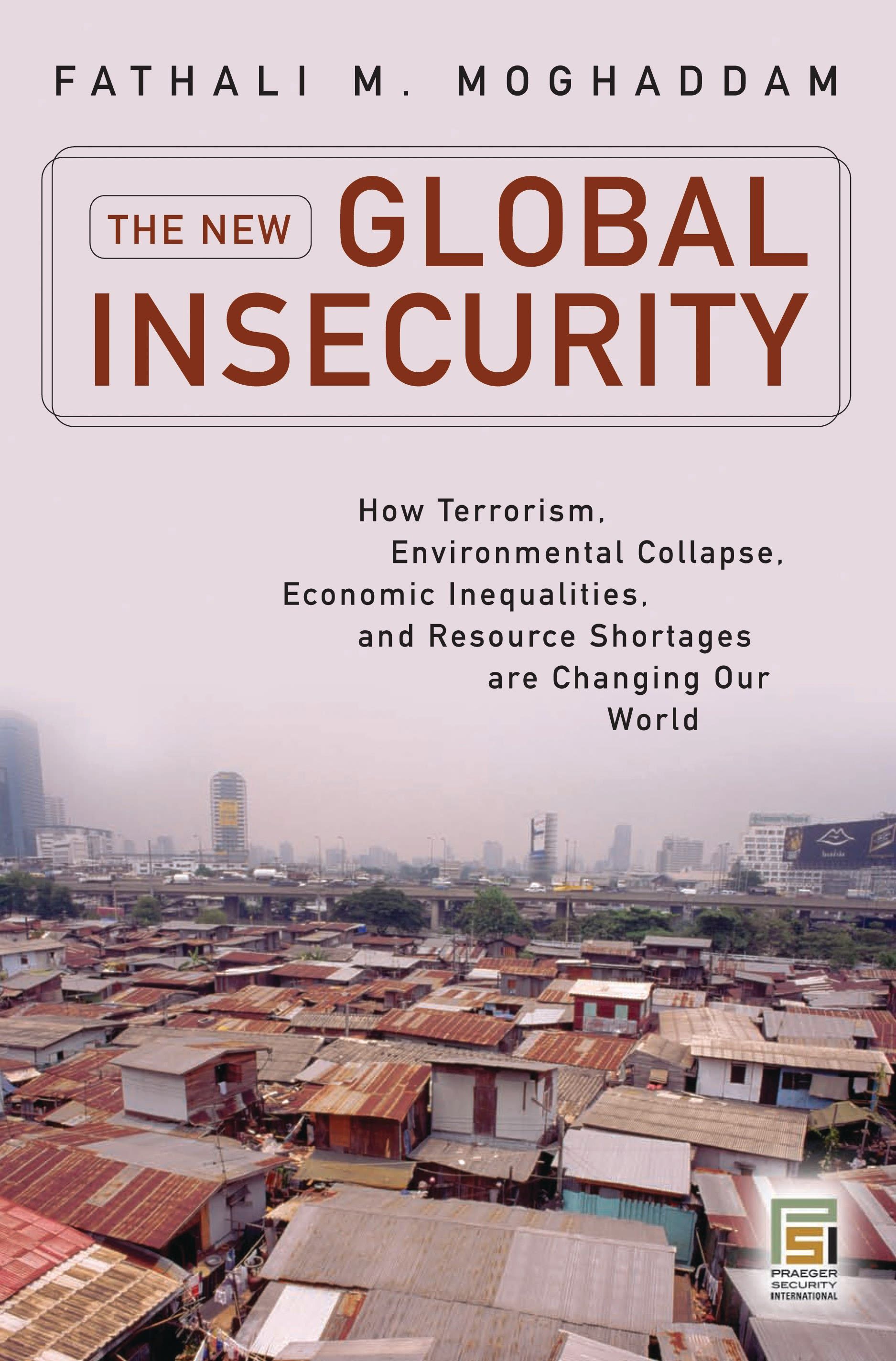
A noted conflict expert shows how accelerating globalization is causing dangerous global insecurity that must be met by new security models and policies.
The New Global Insecurity: How Terrorism, Environmental Collapse, Economic Inequalities, and Resource Shortages Are Changing Our World explores insecurity arising out of accelerating globalization. In this unique and forward-thinking work, psychologist Fathali M. Moghaddam, director of the Conflict Studies Program at Georgetown University, explains how and why worldwide insecurity is rising and what steps we must take to quell or reverse that insecurity to make the future of the world more peaceful.
The book first analyzes the elements and roots of global insecurity, discussing it in relation to terrorism, torture, economic instability, threatened identity, and religious fundamentalism. It then puts forward a new model for understanding security, wherein "soft security capital" serves as the enabling condition for "hard security capital." Finally, the current policies for managing diversity, "multiculturalism" and "assimilation" are both rejected in favor of an exciting new policy—"omniculturalism". Drawing on his years of study and expertise, Moghaddam likewise proposes a new policy for better managing intergroup relations in an insecure age.
The New Global Insecurity: How Terrorism, Environmental Collapse, Economic Inequalities, and Resource Shortages Are Changing Our World explores insecurity arising out of accelerating globalization. In this unique and forward-thinking work, psychologist Fathali M. Moghaddam, director of the Conflict Studies Program at Georgetown University, explains how and why worldwide insecurity is rising and what steps we must take to quell or reverse that insecurity to make the future of the world more peaceful.
The book first analyzes the elements and roots of global insecurity, discussing it in relation to terrorism, torture, economic instability, threatened identity, and religious fundamentalism. It then puts forward a new model for understanding security, wherein "soft security capital" serves as the enabling condition for "hard security capital." Finally, the current policies for managing diversity, "multiculturalism" and "assimilation" are both rejected in favor of an exciting new policy—"omniculturalism". Drawing on his years of study and expertise, Moghaddam likewise proposes a new policy for better managing intergroup relations in an insecure age.
Pages: 212
Category: Statsvetenskap & Politik
e-ISBN: 9798216122692
Shipping weight: 1.2 kg
Ships in: 1-2 days
Pay easily by card, Klarna, Apple Pay or Google Pay. Not happy? You always have a 14-day money-back guarantee. Read more in our terms. If you have any questions, email us at hello@memmo.org.
Memmo makes studying easier – wherever you are in the world. We bring your course books and smart study tools together in one place: summaries, quizzes, podcasts and flashcards. Plus Ted, your study buddy who answers anything you wonder. Over 50,000 students already study here – built to help you learn faster and stress less.