
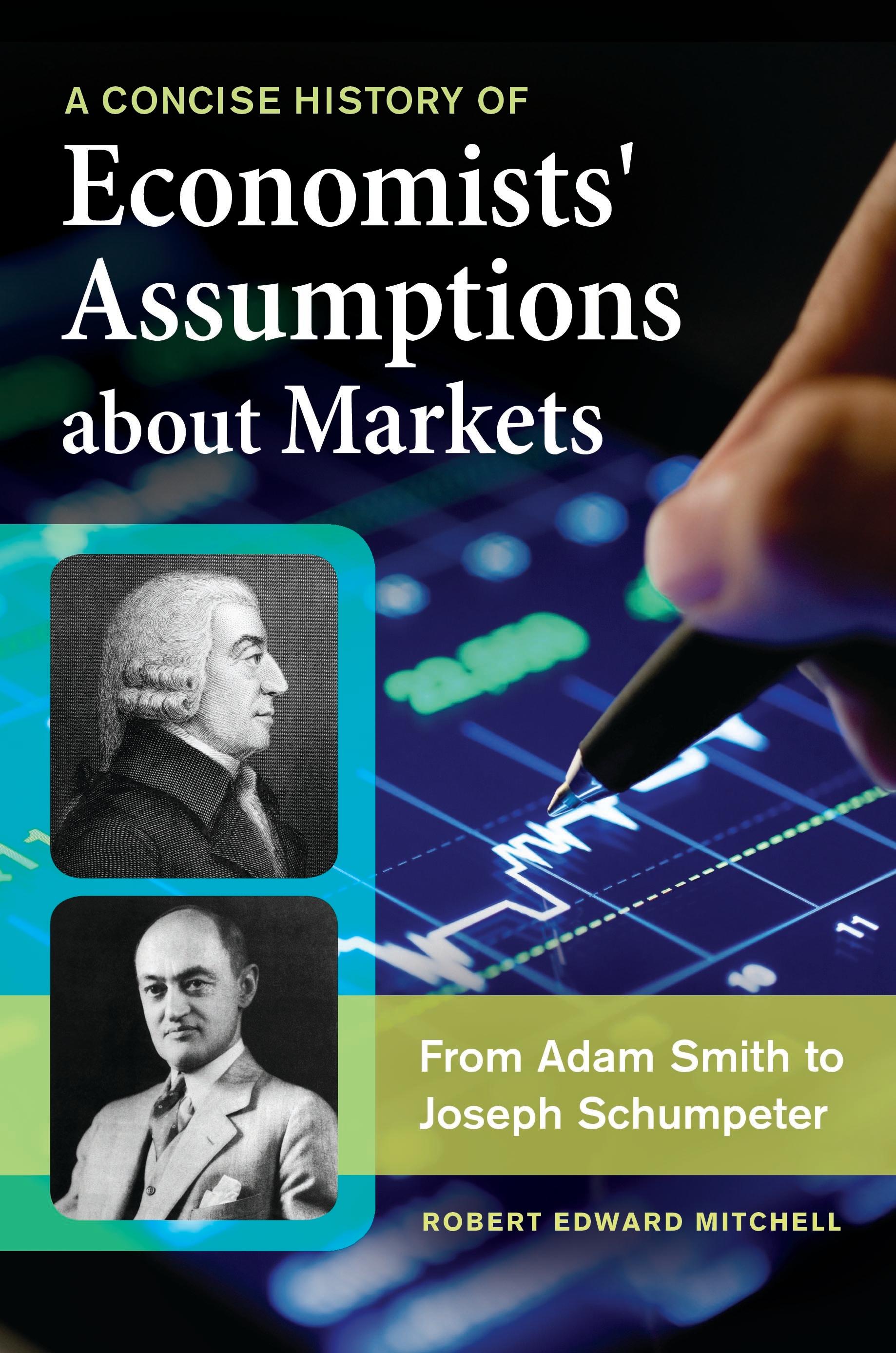
This open-minded, multidisciplinary approach challenges existing world views on the endogenous and exogenous forces that drive markets and economies.
Nine narrative chapters and a conclusion provide an accessible history of key premises and assumptions in the mental models proposed by several major economists since the 1776 publication of Adam Smith's The Wealth of Nations and show how—and why—those models and their underlying assumptions have changed over time. The book addresses the legacies of major economists, describes their historical and analytical influence, documents the interaction among various schools of thought as well as how they differ, and the implications that this history has for economics and the policy sciences in the decades ahead.
The author focuses on the mental maps economists have created in an attempt to understand the forces that destroyed "order," explaining how these maps incorporate a non-mathematical presentation of evolving dictionaries, novel analytical perspectives, new evidence, and a reliance on value assumptions. He traces the underlying assumptions, continuities, and differences among major economists including Adam Smith, Thomas Malthus, David Ricardo, Alfred Marshall, John Maynard Keynes, Karl Marx, Thorstein Veblen, and Joseph Schumpeter. Readers will grasp how the classic theories still influence economists' mental models today and come away with a basic economic literacy that puts this important social science in historical context. This is essential reading for all the social and policy sciences.
Nine narrative chapters and a conclusion provide an accessible history of key premises and assumptions in the mental models proposed by several major economists since the 1776 publication of Adam Smith's The Wealth of Nations and show how—and why—those models and their underlying assumptions have changed over time. The book addresses the legacies of major economists, describes their historical and analytical influence, documents the interaction among various schools of thought as well as how they differ, and the implications that this history has for economics and the policy sciences in the decades ahead.
The author focuses on the mental maps economists have created in an attempt to understand the forces that destroyed "order," explaining how these maps incorporate a non-mathematical presentation of evolving dictionaries, novel analytical perspectives, new evidence, and a reliance on value assumptions. He traces the underlying assumptions, continuities, and differences among major economists including Adam Smith, Thomas Malthus, David Ricardo, Alfred Marshall, John Maynard Keynes, Karl Marx, Thorstein Veblen, and Joseph Schumpeter. Readers will grasp how the classic theories still influence economists' mental models today and come away with a basic economic literacy that puts this important social science in historical context. This is essential reading for all the social and policy sciences.
Pages: 192
Category: Ekonomi & Utveckling
e-ISBN: 9798216064480
Shipping weight: 1.2 kg
Ships in: 1-2 days
Pay easily by card, Klarna, Apple Pay or Google Pay. Not happy? You always have a 14-day money-back guarantee. Read more in our terms. If you have any questions, email us at hello@memmo.org.
Memmo makes studying easier – wherever you are in the world. We bring your course books and smart study tools together in one place: summaries, quizzes, podcasts and flashcards. Plus Ted, your study buddy who answers anything you wonder. Over 50,000 students already study here – built to help you learn faster and stress less.