
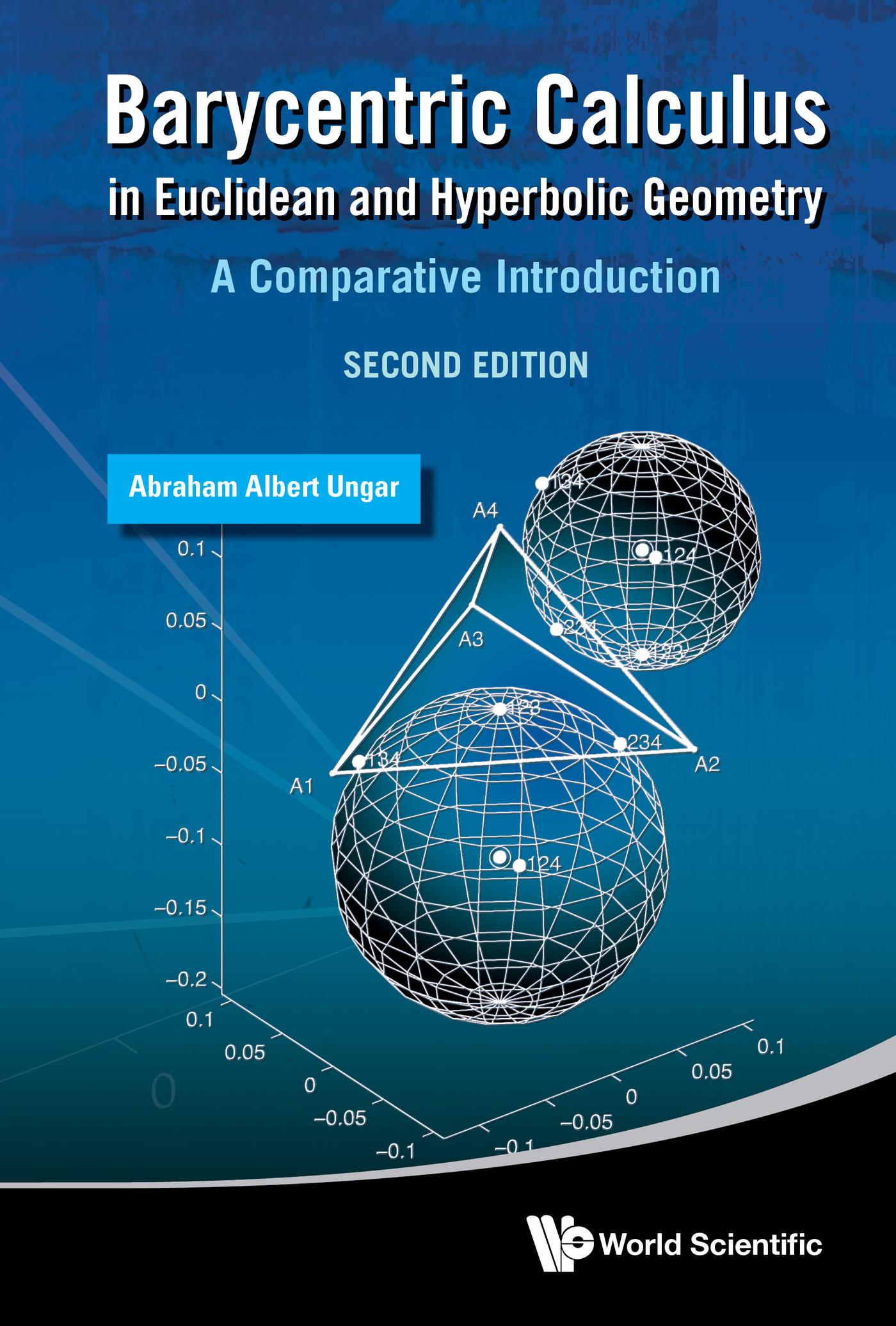
This unique and richly illustrated book explores barycentric calculus, a geometric method grounded in the concept of the center of gravity. Used to elegantly determine triangle centers through weighted points, barycentric coordinates have long revealed deep insights in Euclidean geometry. Now, this book extends those insights to the fascinating realm of hyperbolic geometry, building a powerful bridge between classical and modern mathematical worlds.
In Euclidean geometry, over 3,000 triangle centers have been identified using barycentric coordinates. This book introduces readers to their hyperbolic analogs, uncovering remarkable parallels between triangle centers in Bolyai–Lobachevsky geometry and their Euclidean counterparts. The author's innovative use of Cartesian coordinates, trigonometry, and vector algebra — adapted for hyperbolic geometry — equips readers with familiar yet powerful tools to explore unfamiliar terrain.
At the heart of the book is the development of hyperbolic barycentric coordinates, or gyrobarycentric coordinates, within the framework of gyrovector spaces — a novel algebraic structure emerging from Einstein's velocity addition and Möbius addition. These gyrovectors underpin the Klein and Poincaré ball models of hyperbolic geometry, just as traditional vectors underlie analytic Euclidean geometry.
Whether you are a researcher in geometry, mathematical physics, or relativity, or simply fascinated by the deep structure of space, this book offers a groundbreaking approach to analytic hyperbolic geometry through barycentric and gyrobarycentric coordinates.
Contents:
- Euclidean Barycentric Coordinates and the Classic Triangle Centers
- Gyrovector Spaces and Cartesian Models of Hyperbolic Geometry
- The Interplay of Einstein Addition and Vector Addition
- Hyperbolic Barycentric Coordinates and Hyperbolic Triangle Centers
- Hyperbolic Incircles and Rxcircles
- Hyperbolic Tetrahedra
- Comparative Patterns
- Gyrodistances and Distances
- Ptolemy's Theorem: Euclidean and Hyperbolic
- Cyclic Antipodal Segments
Readership: Undergraduate and graduate students of mathematics who are familiar with the basic vector space approach to Euclidean geometry. Researchers and academics in geometry, algebra, and mathematical physics. Geometers who like to explore hyperbolic geometry. Any academic library of mathematics and physics.
Pay easily by card, Klarna, Apple Pay or Google Pay. Not happy? You always have a 14-day money-back guarantee. Read more in our terms. If you have any questions, email us at hello@memmo.org.
Memmo makes studying easier – wherever you are in the world. We bring your course books and smart study tools together in one place: summaries, quizzes, podcasts and flashcards. Plus Ted, your study buddy who answers anything you wonder. Over 75,000 students already study here – built to help you learn faster and stress less.