
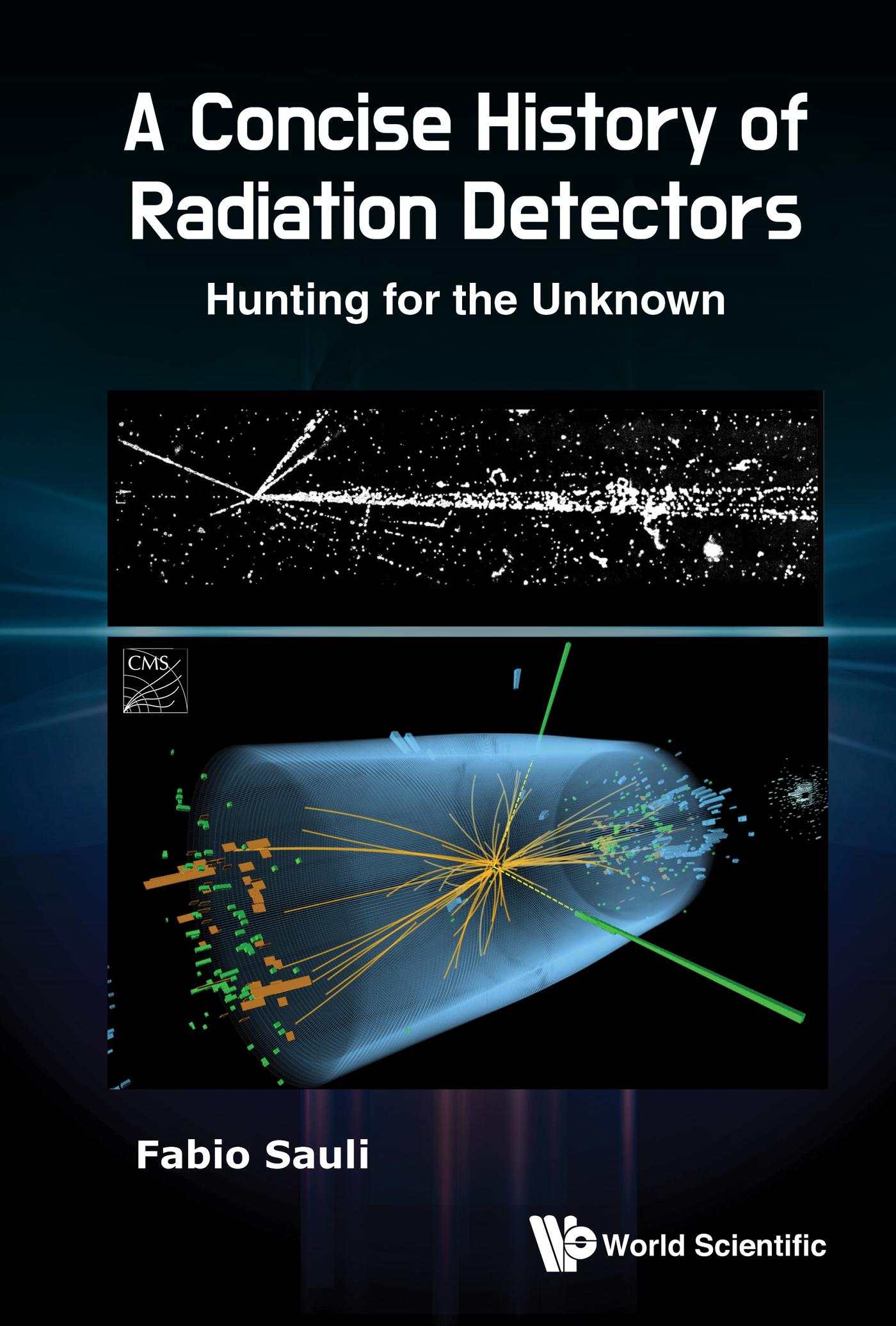
The development of radiation detectors is closely entangled to the study of elementary particles and of their interactions. From the early observations of cosmic rays using photographic emulsions, to the present complex electronic systems operating in high-energy accelerators, this book describes the evolution of detectors employed in particle physics and astrophysics: cloud and bubble chambers, spark chambers, solid state and gaseous position-sensitive detectors. Major discoveries have been made making use of increasingly advanced devices: natural radioactivity, X-rays, π mesons, the positron, the W and the Higgs bosons, only to mention a few. Suitable for practitioners and students of particle physics, this book gives a concise but comprehensive description of the evolution and major applications of radiation detector technologies.
Contents:
- Photographic Plate Emulsions
- Cloud Chambers
- Bubble Chambers
- Spark and Streamer Chambers
- Scintillators and Photon Detectors
- Solid State Radiation Detectors
- Proportional and Geiger Counters
- Multiwire Proportional Chambers
- Drift Chambers
- Resistive Plate Chambers
- Micro-Pattern Gaseous Detectors
- Optical Imaging Chambers
- Cryogenic and Dual-Phase Detectors
- Particle Identification
- Concluding Remarks
Readership: Advanced undergraduates, graduate students, researchers and practitioners in high-energy physics, especially the fields of detectors for particle physics, cosmology, astrophysics and medical diagnostics.
Pay easily by card, Klarna, Apple Pay or Google Pay. Not happy? You always have a 14-day money-back guarantee. Read more in our terms. If you have any questions, email us at hello@memmo.org.
Memmo makes studying easier – wherever you are in the world. We bring your course books and smart study tools together in one place: summaries, quizzes, podcasts and flashcards. Plus Ted, your study buddy who answers anything you wonder. Over 50,000 students already study here – built to help you learn faster and stress less.