
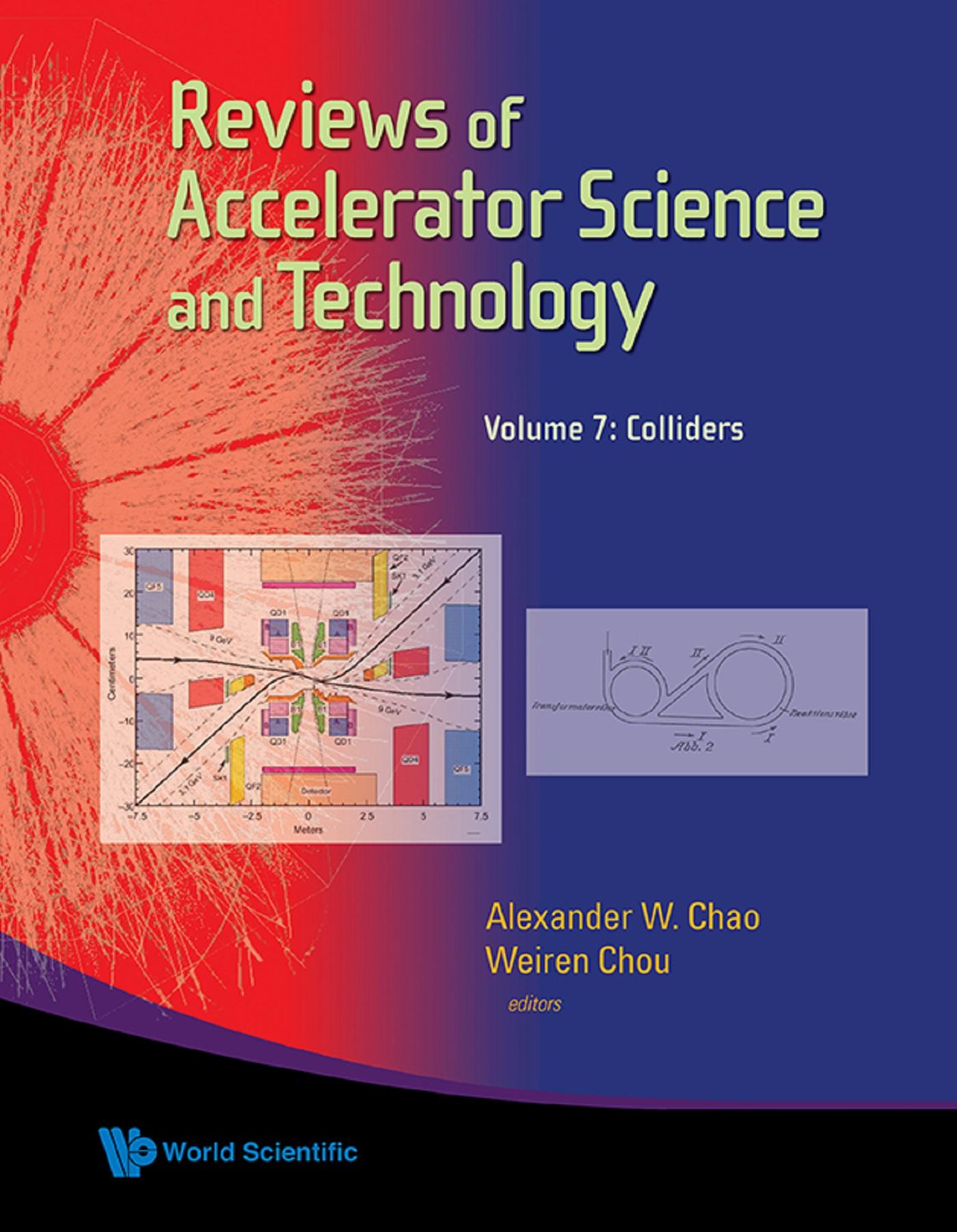
The idea of colliding two particle beams to fully exploit the energy of accelerated particles was first proposed by Rolf Wideröe, who in 1943 applied for a patent on the collider concept and was awarded the patent in 1953. The first three colliders — AdA in Italy, CBX in the US, and VEP-1 in the then Soviet Union — came to operation about 50 years ago in the mid-1960s. A number of other colliders followed.Over the past decades, colliders defined the energy frontier in particle physics. Different types of colliers — proton-proton, proton-antiproton, electron-positron, electron-proton, electron-ion and ion-ion colliders — have played complementary roles in fully mapping out the constituents and forces in the Standard Model (SM). We are now at a point where all predicted SM constituents of matter and forces have been found, and all the latest ones were found at colliders. Colliders also play a critical role in advancing beam physics, accelerator research and technology development. It is timely that RAST Volume 7 is dedicated to Colliders.
Pay easily by card, Klarna, Apple Pay or Google Pay. Not happy? You always have a 14-day money-back guarantee. Read more in our terms. If you have any questions, email us at hello@memmo.org.
Memmo makes studying easier – wherever you are in the world. We bring your course books and smart study tools together in one place: summaries, quizzes, podcasts and flashcards. Plus Ted, your study buddy who answers anything you wonder. Over 50,000 students already study here – built to help you learn faster and stress less.
You might also like
Buy the book0