
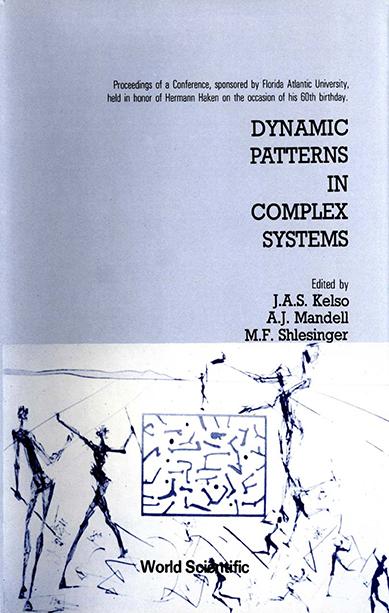
Contents:
Readership: Graduate students and academics interested in complex systems. Students and researchers in science (physics, chemistry, mathematics, biology) and engineering. Physicists and other scientists, social scientists, humanists and laypeople.
- Part I - Pattern Formation and Pattern Recognition in Multistable Systems:
- Pattern Recognition and Pattern Formation as Dual Processes (H Haken & A Fuchs)
- Holovision: A Semantic Information Processor for Visual Perception (H. Shimizu, Y Yamaguchi & K Satoh)
- Dynamic Patterns of Biological Coordination: Theoretical Strategy and New Results (G Schaner & J A S Kelso)
- Fluctuations in Bistable Tunnel Diode Circuit (with Editors' Introduction) (R. Landauer)
- Temporal and Spatial Patterns in Chemical Systems (H L Swinney, W Horsthemke, W D McCormick, Z Nosz ticzins & W Y Tam)
- Fractal Distributions Useful for Search Algorithms (H H Szu)
- Part II - Pattern Generation in Neurobiological Systems:
- Invertebrate Central Pattern Generators as Computational Data Bases (A.l Selverston)
- Studies of the Lamprey Central Pattern Generator for Locomotion: A Close Relationship between Modelling and Experimentation (A H Cohen)
- Appendix to Cohen's Paper: Chains of Oscillators and the Effects of Multiple Coupling (N Kopel)
- Variability and Chaos: Neurointegrative Principles in Self-Organization of Motor Patterns (G J Mpitsos, H C Creech, C S Cohan & M Mendelson)
- Part III- Chaos, Coding and Fractals:
- Self- Similar Basin Boundary in an Invertible System (Folded-towel map) (O E Rossler, J L Hudson, M Klein & R Wais)
- An Unstable Singularity Theory of Molecular Biological Coding: Calcitonin's Structures and Potencies (A J Mandell)
- Fractal Models in Physiology (B West)
- Sudden Death is Not Chaos (A L Goldberger & D R. Rigney)
- Predicting Chaotic Dynamics (J D Farmer & J J Sidorowich)
- Adaptation Toward the Edge of Chaos (N H Packard)
- Part IV - Action, Perception and Developing Systems:
- The VITE Model: A Neural Command Circuit for Generating Arm and Articulator Trajectories (D Bullock & S Grossberg)
- Simplicity from Complexity: Archetypal Action Regimes and Smart Perceptual Instruments as Execution- Driven Phenomena (M T Turvey)
- Dynamical Approaches to the Development of Behavior (E Thelen)
- Critical Behavior in Perception- Action Systems (W H Wamn, Jr)
Readership: Graduate students and academics interested in complex systems. Students and researchers in science (physics, chemistry, mathematics, biology) and engineering. Physicists and other scientists, social scientists, humanists and laypeople.
Pay easily by card, Klarna, Apple Pay or Google Pay. Not happy? You always have a 14-day money-back guarantee. Read more in our terms. If you have any questions, email us at hello@memmo.org.
Memmo makes studying easier – wherever you are in the world. We bring your course books and smart study tools together in one place: summaries, quizzes, podcasts and flashcards. Plus Ted, your study buddy who answers anything you wonder. Over 50,000 students already study here – built to help you learn faster and stress less.
You might also like
Buy the book0