
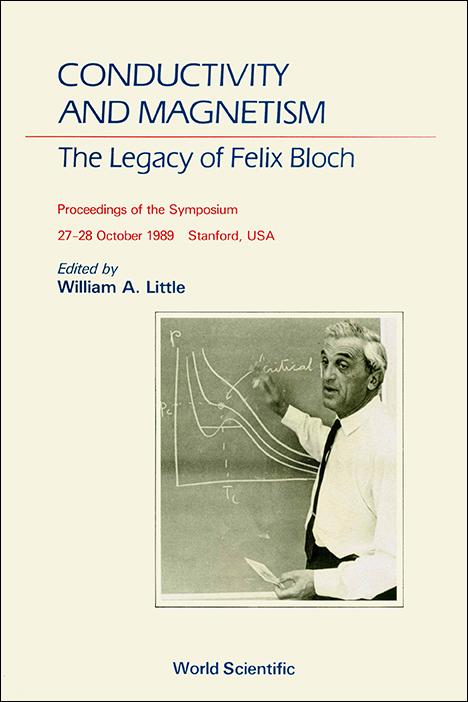
Felix Bloch was one of the foremost scientists of the 20th century. His work on the theory of metals in 1929 laid the cornerstone for the development of semiconductors and his work on magnetism was crucial for the development of a basic understanding of ferromagnetism. Nuclear Magnetic Resonance, which he discovered in 1946, and for which he shared the Nobel Prize with Edward Purcell in 1952, has become the most important spectroscopic tool in Chemistry. The year 1989 marks the sixtieth year since Bloch's paper on the Theory of Metals. This Symposium celebrated the occasion by gathering a group of distinguished scientists who presented overviews of the past, present and future of several major areas of Physics, Chemistry, Engineering, Computer Science, Biology and Medicine, many of which trace their origins to Bloch's influence.
Pay easily by card, Klarna, Apple Pay or Google Pay. Not happy? You always have a 14-day money-back guarantee. Read more in our terms. If you have any questions, email us at hello@memmo.org.
Memmo makes studying easier – wherever you are in the world. We bring your course books and smart study tools together in one place: summaries, quizzes, podcasts and flashcards. Plus Ted, your study buddy who answers anything you wonder. Over 50,000 students already study here – built to help you learn faster and stress less.
You might also like
Buy the book0